By Lucia Stein, Policy Assistant and James Dysart, Associate Policy Director
Introduction
More than 18,000 families with children, on average, slept in New York City Department of Homeless Services (NYC DHS) shelters each night during the first half of the 2025 calendar year.1 Yet in that same amount of time, across three major New York City daily news outlets, only 62 articles touched on family homelessness. The publications contained limited coverage of family homelessness and that coverage rarely delved into key policy areas or topics connected to the issue.
Whether one consumes news through print, broadcast, or social media, a new story is always breaking. Sifting through information can feel overwhelming, even for those whose job it is to sort through the noise. What happens, then, to the stories that are not emergent, not necessarily “exciting” to the outsider, but still illuminating a full-fledged crisis that affects thousands? When these stories are shared, what do they include? We asked these questions about family homelessness in NYC. Our analysis explores how NYC news outlets cover family homelessness and the policy areas tied to it.
Our findings raise an essential question: How can these connections between family homelessness and related policy areas be communicated so they strengthen the broader public understanding of family homelessness?
Methodology
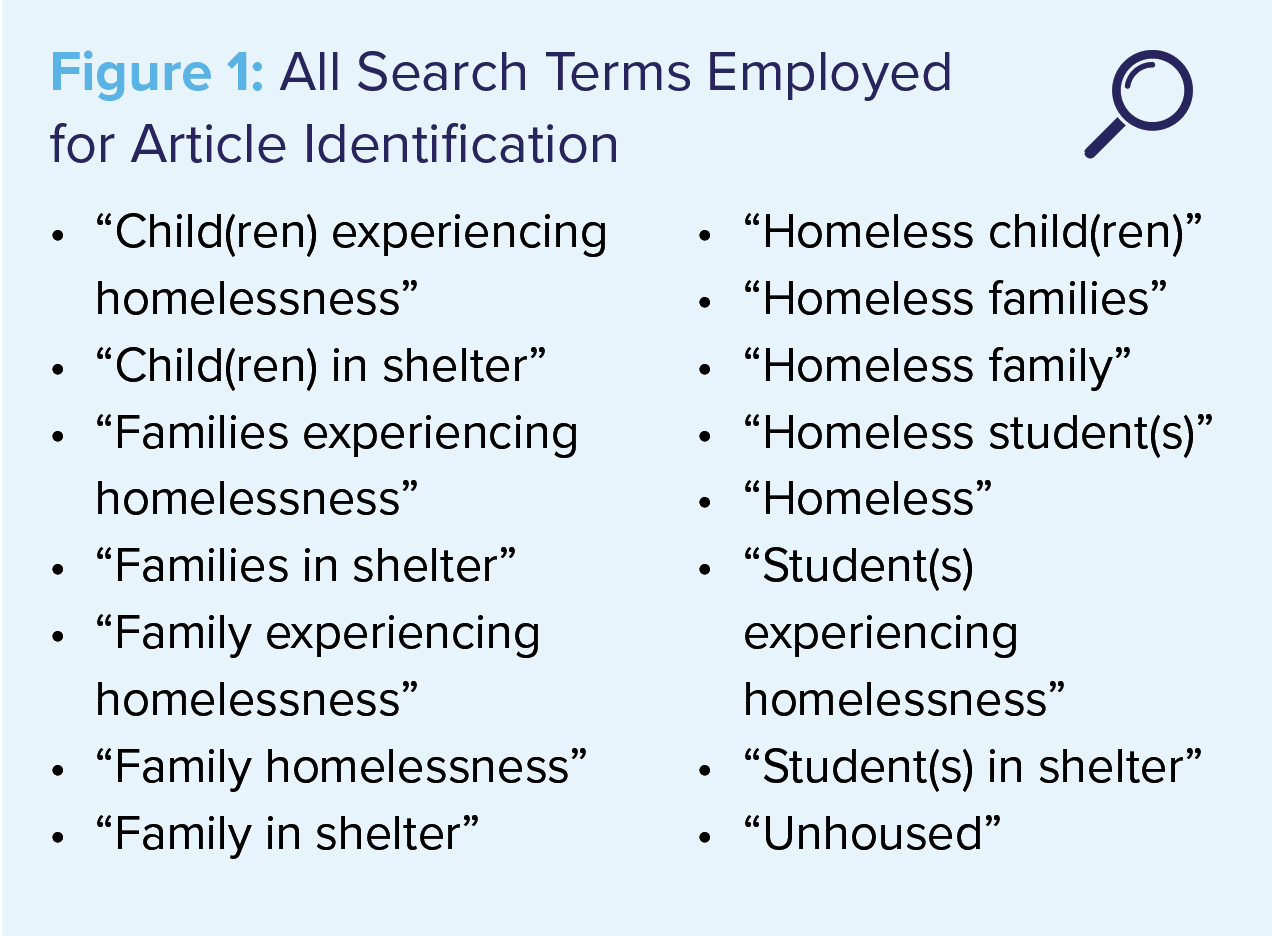
We used 15 search phrases meant to capture all articles involving family or child homelessness across three publications (New York Daily News, New York Post, The New York Times) between January and June of 2025 (see Figure 1). These publications were chosen as they are three of the top New York City dailies with the widest circulation.2 The search yielded more than 1,000 articles but included articles with content that was outside the scope of our analysis. Therefore, we checked all the articles and excluded them if they were unrelated to NYC or did not mention family homelessness.i
Articles were reviewed to determine whether family homelessness was a “focus” or a “mention.” A “focus” classification was assigned when the issue was central to the story, and a “mention” classification was assigned when it appeared only as a supporting detail. Finally, we documented any references to specific policy areas related to family homelessness.3
News coverage is influenced by local, national, and international developments, such as the thousands of asylum-seeking families who lived in NYC shelters beginning in 2022. As new arrivals slowed, the City began closing “migrant shelters” during our review period.4 This, combined with ongoing tensions surrounding immigration, meant that our review of family homelessness news coverage was more likely to include mentions of these policy areas. The 2025 primary elections for NYC mayor also occurred in June 2025, at the very end of our review period. In the interest of assessing how family homelessness was connected to the campaign, we tracked Elections as a policy area, which might have been overrepresented.
Much of the annual news coverage of family and child homelessness in NYC occurs in the second half of the calendar year from July through December. News about families experiencing homelessness often responds to research and policy reports, audits, and legislative sessions, like the NYC Mayor’s Management Report (MMR), published each September, or reports about the number of homeless students in the NYC public school system, which usually come out in the fall.5,6 The federal government typically releases national reports like the Annual Homelessness Assessment Report (AHAR) in December.7 The end of the year often sees additional coverage of family homelessness due to perennial feel-good stories about Thanksgiving, toy drives, and the holidays.8,9 The New York Times even has a specific initiative covering social services agencies and nonprofits occurring in late November and December each year to encourage philanthropy.10 While this means news outlets likely publish fewer articles concerning family homelessness during the timeframe covered in this project, these first six months of the year are no less important to review. The NYC family homelessness crisis occurs year-round, not solely when organizations release reports or the holiday season comes around. Reviewing how outlets cover family homelessness from January through June is therefore vital regardless of, or even because of, this fact. Out of all the individuals in NYC DHS shelters during the review period, an average of 69% were members of families with children, yet one might have no idea from the news coverage.11
i. We included articles about national developments since such events affect NYC.
Analysis and Key Takeaways
1. Family Homelessness Coverage Was Limited
A six-month review of three major NYC daily news outlets revealed only 62 articles that referenced family homelessness in NYC. Thirty-one articles (50%) were from The New York Times, 18 (29%) were from the New York Daily News, and 13 (21%) were from the New York Post.
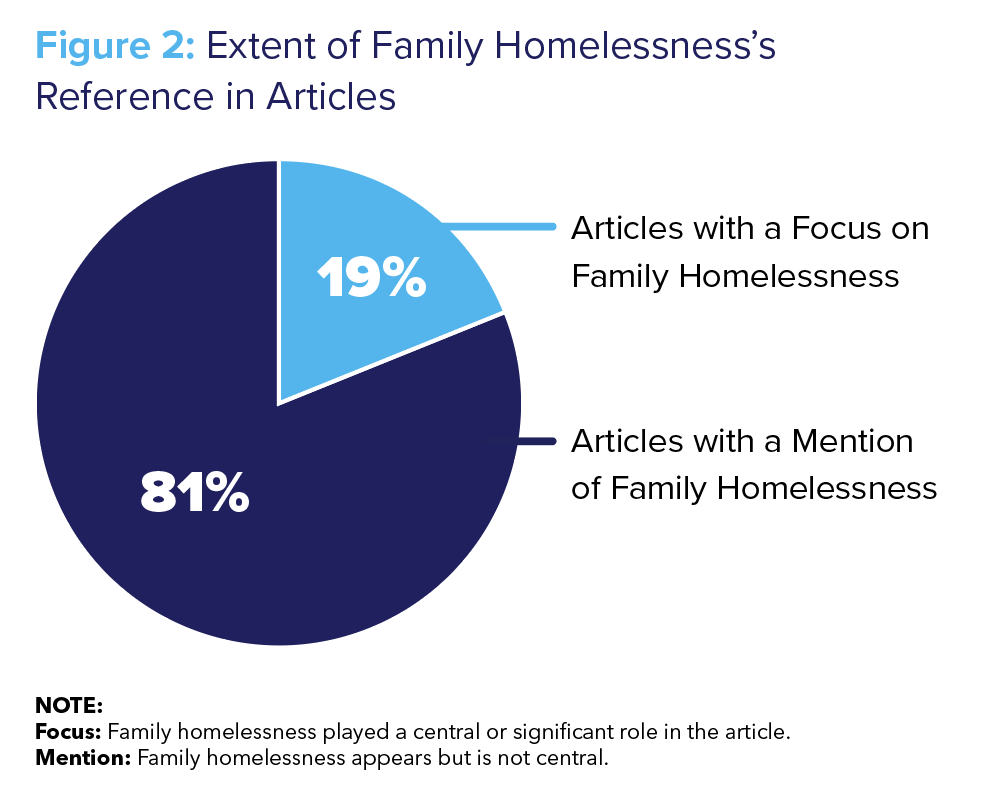
Only 12 articles (19%) focused on family homelessness. The remaining 50 articles (81%) only mention family homelessness as an aside or a supplementary detail (see Figure 2).
Other outlets outside the scope of our analysis, such as nonprofit newsrooms like City Limits, Gothamist, or The City Reporter, may have covered family homelessness during the same period, filling the void in the coverage. Additionally, the publications in this analysis may also have covered the issue more extensively or with more frequency at other times. For example, in late July, outside the parameters of this analysis, The New York Times published a story highlighting overcrowding, discord, or unlivable conditions as major reasons families enter shelter.12 Considering the ongoing nature of the family homelessness crisis, however, the conversation around family homelessness can and should be louder.
2. Shelter and Safety Were Major Focus Areas of Coverage—A Possible Reflection of Daily Visibility
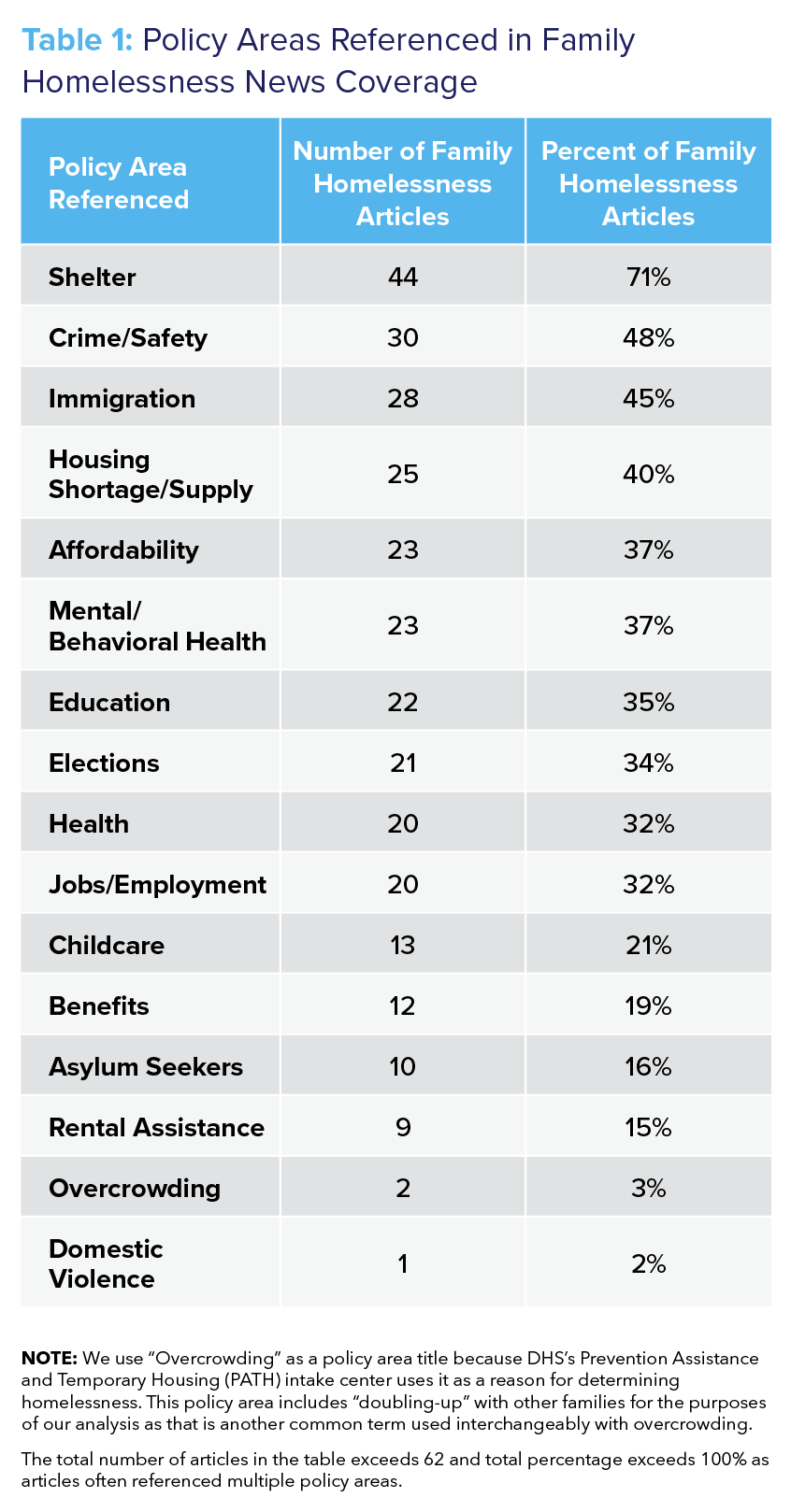
Shelter was the most referenced policy area, appearing in 71% of family homelessness articles (see Table 1). Every article that focused on family homelessness mentioned shelter or temporary housing. This connection is not surprising as New York has a unique right to shelter, which requires the City to provide temporary shelter for families.13 This allows families to receive lifesaving emergency assistance during a crisis. Because the crisis does not play out in public spaces, family homelessness may be a less visible part of daily life to New Yorkers who are not confronted with it. This lack of visibility may contribute to the limited news coverage we observed. Future research should investigate the actual conversations around shelter in coverage, to ensure the purpose and need for high-quality service-rich shelter is adequately addressed.
The second most-referenced policy area was one added during our analysis. Crime/Safety was not initially a policy area that we used to evaluate family homelessness coverage, but during the analysis we found that 48% of the articles (see Table 1) were tied to this area. This underscores that family homelessness—and homelessness in general—may only become more visible when tied to New Yorkers’ overall notions of crime, safety, and quality of life.
3. Coverage Highlighted Connections to Broad Issues While Missing Major Drivers of Family Homelessness
We also looked at the intersection between family homelessness coverage and policy areas that contribute to family homelessness or drive families into shelter. These policy areas included Affordability, Domestic Violence, Housing Shortage/Supply, Jobs/Employment, and Overcrowding.14,15,16,17
Coverage focused most often on Housing Shortage/Supply (40%) and Affordability (37%). These are important drivers of family homelessness, so it is encouraging to see articles that make the link between these broader policy areas and family homelessness. However, our analysis does not look at every article that mentions the housing shortage/supply and affordability—only those that reference family homelessness—so we cannot be certain about what percentage of the overall coverage of these policy areas includes family homelessness as an effect.
In contrast, Domestic Violence (2%), and Overcrowding (3%), two major drivers of shelter entry, were the two least-referenced policy areas. It could be possible that this lack of coverage stems from vulnerability and privacy concerns relating to these issues. However, prior national analyses found that media coverage rarely mentioned gender or the fact that many families experiencing homelessness are female-headed, single parent households.18 This gap may help explain why our review included so few references to gender-based or partner violence. A national study from 2014 found that families who leave shelter without permanent housing often double up and later return to shelter.19 These families may disappear from coverage once they are no longer considered “literally homeless.”20 This invisibility contributes to missing the structural factors that drive family homelessness. Considering their impact on family homelessness, it is alarming that Domestic Violence and Overcrowding received so little attention.
- In Fiscal Year 2024, one-third or 32% of families with children at DHS shelters experienced homelessness because of domestic violence.21
- Overcrowding, Discord, and Unlivable Conditions were listed as the reasons for homelessness among 19% of families with children who entered DHS shelters in Fiscal Year 2024.22 During the 2024–2025 school year, more than 82,000 NYC public school students who experienced homelessness spent time “doubled-up,” meaning they were sharing the housing of friends or family members.23
4. Coverage Left Gaps in Recognizing Families as in High Need of Support
The policy areas of Rental Assistance, Benefits, and Childcare also received low rates of coverage. These areas were referenced in 15%, 19%, and 21% of articles, respectively. These policy areas in practice often prove vitally important to the lives of families experiencing homelessness. Families depend on rental assistance to move to permanent housing.24 They also need access to other benefits to afford necessities like groceries and childcare while living in shelter or maintaining their housing.25
Childcare presents a significant yet often overlooked need for families. It allows adults in families experiencing homelessness to work, often in jobs with irregular hours.26 The lack of coverage was unexpected considering publications have highlighted recent conversations around the rising cost of care since at least 2022, and childcare has been a continued focus for New Yorkers throughout the timeframe of this review. It is important to note, however, that this is likely not due to a lack of coverage of childcare, but a lack of coverage in connection with family homelessness.
This limited amount of connected coverage raises potential questions about why links between family homelessness and relevant policy areas do not often appear. Our analysis did not seek to answer these questions, but to find where they might exist, creating the opportunity for related analysis either by ICPH or others.
Conclusion
This data raises important questions about how to ensure that families’ experiences are visible, understood, and reflected in news coverage. It also challenges those interested in ensuring coverage of family homelessness, including advocates, nonprofit service providers, government agencies, families impacted by homelessness or with lived experience, and other people and organizations interested in helping, to find allies across policy issues. These are questions each organization must answer for itself, but we hope this analysis supports that work and helps guide a set of questions to continue the conversation around family homelessness.
Recommendations:
 Work Together Across Organizations to Improve Coverage
– Build stronger relationships between nonprofits and news outlets.
– Connect with news organizations to understand how stories are picked up and how to share information about family homelessness more effectively.
 Address All the Main Causes of Family Homelessness
– Elevate other causes of family homelessness, while still affirming housing shortages as a major driver.
– Highlight the major roles played by issues like gender-based violence and poverty.
 Highlight the Services Families Need
– Help allies understand the importance of services like childcare, job
opportunities, and education for families experiencing homelessness.
References
1. NYC OpenData. “DHS Daily Report.” Accessed March 5, 2026. https://data.cityofnewyork.us/Social-Services/DHS-Daily-Report/k46n-sa2m/about_data. Note: Data from January 1, 2025—June 30, 2025
2. “Top 30 Newspapers in New York.” Muck Rack. Accessed April 9, 2026. https://muckrack.com/rankings/top-30-new-york-newspapers.
3. Institute for Children, Poverty & Homelessness. “Family Homelessness 101: New York City.” ICPH.org, June 30, 2025. https://www.icph.org/reports/family-homelessness-101-new-york-city-2/#the-hidden-homeless.
4. Ferré-Sadurní, Luis. “Manhattan Hotel Shelter That Became Symbol of Migrant Crisis Will Close.” The New York Times, February 24, 2025. https://www.nytimes.com/2025/02/24/nyregion/roosevelt-hotel-migrant-shelter-closing.html?searchResultPosition=176.
5. NYC Mayor’s Office of Operations. “Mayor’s Management Report (MMR).” NYC.gov, Accessed February 11, 2026. https://www.nyc.gov/site/operations/reports/mmr.page.
6. Advocates for Children of New York. “Student Homelessness in New York City, 2024–2025.” Oct 20, 2025. https://advocatesforchildren.org/policy-resource/student-homelessness-data-2025/.
7. Office of Policy Development and Research. “Annual Homelessness Assessment Report.” HUDUser.gov, Accessed February 11, 2026. https://www.huduser.gov/portal/sites/default/files/pdf/2024-AHAR-Part-1.pdf.
8. Clark, Roger. “Toy Drive Aims to Collect 10K Toys for Homeless Kids.” Spectrum News NY1, December 3, 2024. https://ny1.com/nyc/all-boroughs/news/2024/12/02/homelessness–holidays–toys–kids.
9. Ramos, Danielle. “Looking for Ways to Give? Here Are 17 NYC Metro Area Toy Drives and Charities to Support for the Holidays.” amNY, November 29, 2025. https://www.amny.com/lifestyle/holidays/nyc-toy-drives-charities-support-holidays/.
10. “About The New York Times Communities Fund.” The New York Times, November 14, 2023. https://www.nytimes.com/2023/11/14/opinion/nyt-communities-fund-about.html.
11. NYC OpenData. “DHS Daily Report.” Accessed March 5, 2026. https://data.cityofnewyork.us/Social-Services/DHS-Daily-Report/k46n-sa2m/about_data. Note: Data from January 1, 2025—June 30, 2025
12. Nir, Sarah Maslin. “The Hidden Victims of New York’s Worsening Housing Crisis.” The New York Times, July 26, 2025. https://www.nytimes.com/2025/07/26/nyregion/nyc-overcrowding-homeless.html.
13. New York City Department of Homeless Services. “Additional Resources.” Accessed April 9, 2026. https://www.nyc.gov/site/dhs/shelter/resources/resources.page.
14. Office of the New York State Comptroller. “New Yorkers in Need.” OSC.NY.gov, June 7, 2024. https://www.osc.ny.gov/files/reports/pdf/new-yorkers-in-need.pdf.
15. New Destiny Housing. “A Crisis Compounded: The Dual Crises of Domestic Violence and Homelessness.” July 2024. https://newdestinyhousing.org/wp-content/uploads/DV-Report-1.pdf.
16. New York City Department of Housing Preservation and Development. “New York City’s Vacancy Rate Reaches Historic Low of 1.4 Percent, Demanding Urgent Action.” News release, February 8, 2024, https://www.nyc.gov/site/hpd/news/007-24/new-york-city-s-vacancy-rate-reaches-historic-low-1-4-percent-demanding-urgent-action-new#/0.
17. Collyer, Sophie, Christopher Wimer, and Matthew Maury. “Shortchanged: Underemployment in New York City.” Robin Hood Foundation and Columbia University, October 2017. https://robinhood.org/wp-content/uploads/2023/07/POVERTY_TRACKER_REPORT7.pdf.
18. Williams, Jean Calterone, Nick H. Hopkinson, Alex Martinez Perez. “Framing Family Homelessness in the United States: Media Representations and the Invisibility of Families.” Journal of Poverty and Social Justice 20, no. 2 (2024): 10, https://doi.org/10.1332/17598273Y2024D000000030.
19. Fisher, Benjamin W., Lindsay S. Mayberry, Marybeth Shinn, and Jill Khadduri. “Leaving Homelessness Behind: Housing Decisions Among Families Exiting Shelter.” Housing Policy Debate 24, no. 2 (2014): 364–86. https://doi.org/10.1080/10511482.2013.852603.
20. Bassuk, Ellen, Carmela DeCandia, and Molly Richard. Services Matter: How Housing and Services Can End Family Homelessness. The Bassuk Center on Homeless and Vulnerable Children and Youth, 2015. https://firstwitness.org/wp-content/uploads/2021/07/How-Housing-Services-Can-End-Family-Homelessness.pdf.
21. Coalition for the Homeless. “State of the Homeless 2025.” June 2025. https://www.coalitionforthehomeless.org/state-of-the-homeless-2025/#drivers-of-homelessness.
22. Ibid.
23. Advocates for Children of New York. “Student Homelessness in New York City, 2024–2025.” 2025.
24. Office of the New York City Comptroller. “Review of the New York City Department of Homeless Services’ Programs and Services.” NYC.gov, August 21, 2023. https://comptroller.nyc.gov/reports/review-of-the-new-york-city-department-of-homeless-services-programs-and-services/.
25. Burt, Martha, Jill Khadduri, and Daniel Gubits. “Are Homeless Families Connected to the Social Safety Net?” Office of Planning, Research and Evaluation (OPRE), Administration for Children and Families, U.S. Department of Health and Human Services, 2016. https://acf.gov/sites/default/files/documents/opre/opre_homefam_brief1_hhs_participation_benefits_programs_033016_b508.pdf.
26. Institute for Children, Poverty & Homelessness. “Leaps and Hurdles: Early Education and Care in New York City: History, Challenges, and Implications for Homeless Children.” ICPH.org, July 20, 2023. https://www.icph.org/reports/leaps-and-hurdles-early-education-and-care-in-new-york-city-history-challenges-and-implications-for-homeless-children/.