By: James Dysart, Associate Policy Director
As we enter 2026 under a new mayoral administration, we look back at family homelessness in New York City during 2025 as an indicator of what challenges may lie ahead. In 2025, there was an average of 18,057 families with children living in NYC Department of Homeless Services (DHS) shelters each night, a 6% decrease from the previous year.1 On January 1, 2025, 18,907 families with children lived in DHS shelters.2 By the end of 2025 the number of families decreased by around 7%, to a total of 17,617 families.3
At first glance, some may want to attribute this decline exclusively to a decrease in the number of asylum seekers entering the shelter system. However, on November 30, 2025 (the most recent data for asylum seekers in shelter), there were 7,261 asylum seeker families in DHS shelters and 17,627 total families in DHS shelters.4 While the immediate shelter needs of every family matter, it is important to dig deeper and note that the majority (59%) of the DHS family shelter system continues to serve families who were relying on shelter before the influx of asylum seekers.5 We should not overlook a promising sign. Despite an affordability crisis in New York City, there was an increase in families placed into permanent housing over the course of last fiscal and calendar year according to the Mayor’s Management Report (MMR), an annual public report of performance metrics for city agencies, which appears to have impacted the overall family shelter population.6 However, there is still substantial work that must be done as the Zohran Mamdani Mayoral Administration begins. On the day he took office, 30,600 children in over 17,600 families slept in DHS shelters.7 Modern Mayors have struggled to find long-term solutions for family homelessness and reduce the number of families staying in temporary shelter. As the new administration works toward solutions, learning from past administrations will be key.
The Prevention Assistance and Temporary Housing (PATH) intake center in the Bronx is DHS’ only location for families with children to apply for shelter. According to DHS reports, an average of 133 families applied for shelter each day in 2025.8 Even as the average number of families in shelter declined by approximately 7% from 2024, when daily applications averaged 143 families.9 This high number of daily applications reflects the ongoing need among NYC families for temporary shelter.
See Figure 1 and Figure 2 for an overview of key metrics related to family homelessness in New York City. Each number represents a family navigating instability as New York City searches for concrete solutions. These families have been affected on the individual level by both systemic issues and policy failures that drive the family homelessness crisis. As we enter 2026, these metrics underscore the urgency to build lasting solutions and support the most vulnerable New Yorkers.
Figure 1
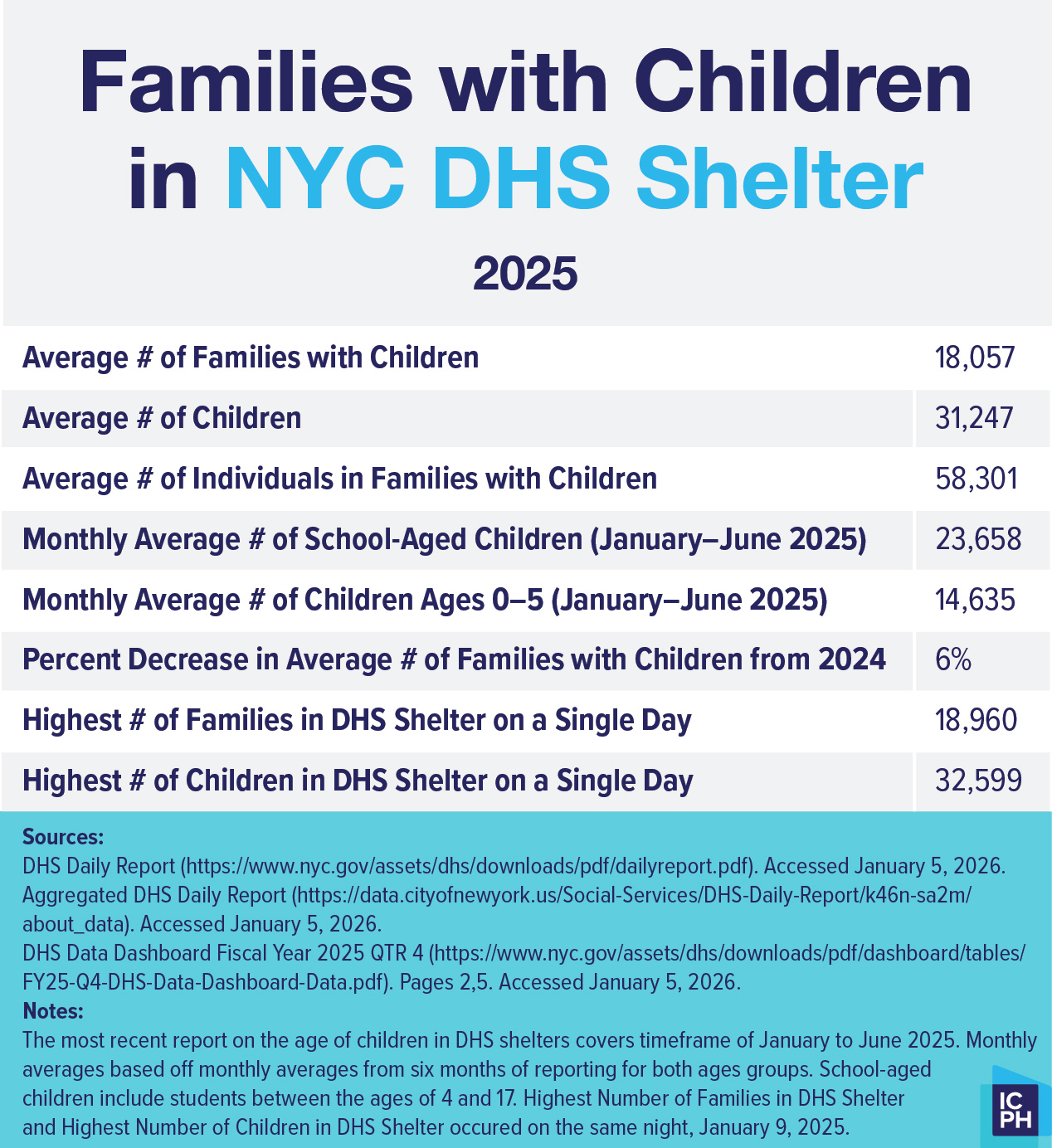 Figure 2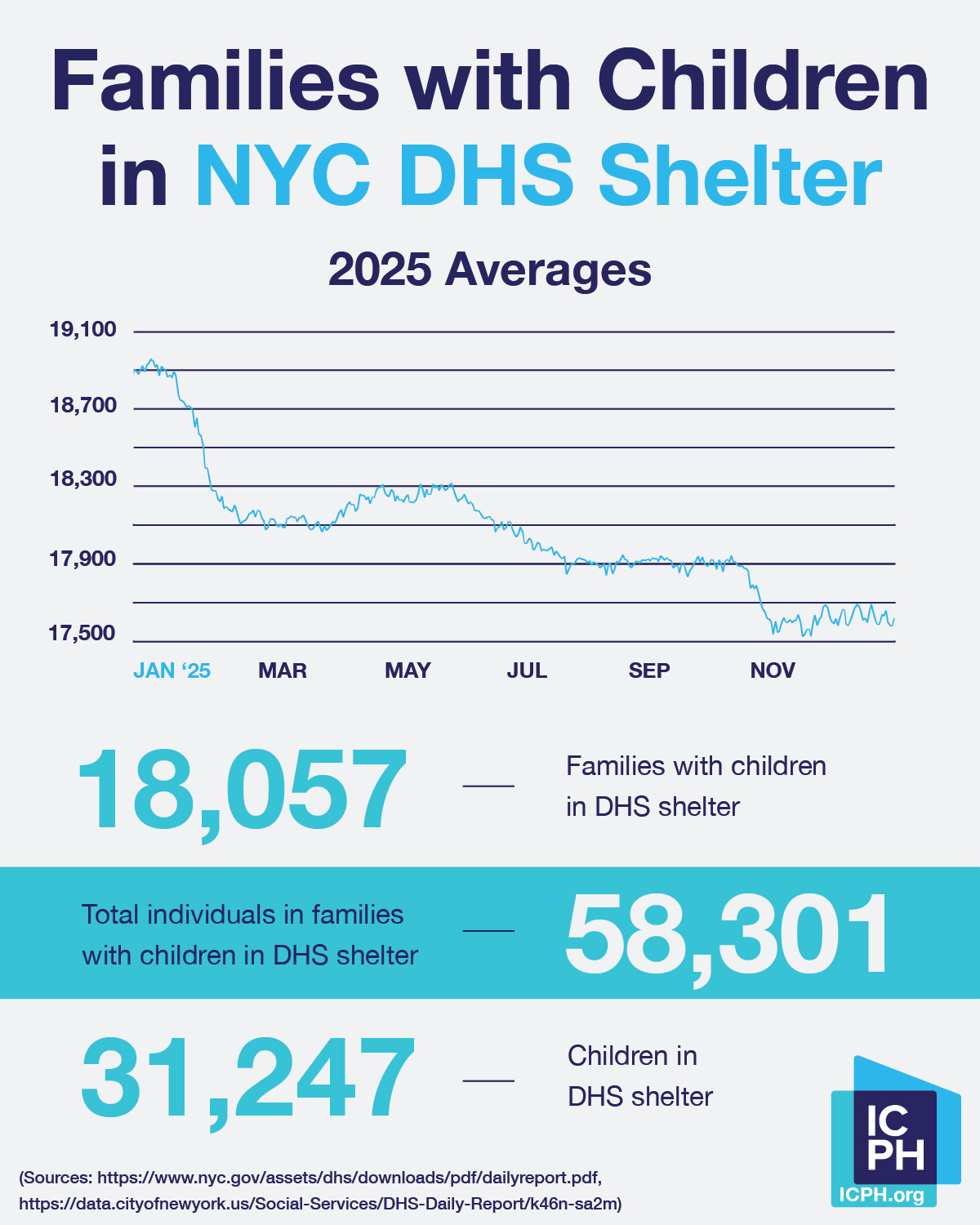
For more information on how previous New York City mayors have managed family homelessness, check out our past report; What We Can Learn About Family Homelessness from the Last Six Mayoral Administrations.
Check out our interactive comparison for the Number of Families with Children in NYC DHS Shelter. Read our 2024 snapshot on family homelessness here.
Data Sources
- Department of Homeless Services. “DHS Daily Report.” NYC Open Data. https://data.cityofnewyork.us/Social-Services/DHS-Daily-Report/k46n-sa2m. Accessed January 5, 2025.
- Ibid.
- Ibid.
- New York City Council. “Asylum Seekers Terms and Conditions Report, November 2025.” 2025. 3. https://council.nyc.gov/budget/wp-content/uploads/sites/54/2025/12/Asylum-Seekers-Report-November-2025.pdf . Accessed January 5, 2025.
- Ibid. Percentage based on number of asylum seeker families in DHS compared to all families in DHS census on same date, November 30, 2025.
- Mayor’s Office of Operations. Families with children exiting to permanent housing. https://dmmr.nyc.gov/city-services/health-and-human-services/department-of-homeless-services/10947. Accessed January 5, 2025. Fiscal Year 2025 includes period of July 1, 2024, to June 30, 2025. Most recent available data published is from September 2025.
- Department of Homeless Services. “DHS Daily Report.” NYC Open Data. https://data.cityofnewyork.us/Social-Services/DHS-Daily-Report/k46n-sa2m. Accessed January 5, 2025.
- Department of Homeless Services. “DHS Daily Report.” https://www.nyc.gov/assets/dhs/downloads/pdf/dailyreport.pdf. Accessed January 5, 2025. DHS makes PATH application data available on DHS Daily Report, these reports are not archived or published every day. Calculation for the average number of PATH applications in 2025 is based on 236 published reports archived by ICPH.
- Ibid.