By: Lucia Stein, Policy Assistant
Families exiting shelter have historically been most successful in securing permanent housing when assisted with government housing vouchers. These vouchers can be funded through federal, state, local, or a combination of government dollars. But maintaining funding and political support for those vouchers has been a challenge, and so, in turn, maintaining housing can be a challenge for families when voucher programs change or end, especially in competitive housing markets like New York City (NYC).
NYC’s current housing assistance program, the City Fighting Homelessness and Eviction Prevention Supplement (CityFHEPS) has helped secure permanent housing for over 87,000 individuals, including many families with children, since its inception in 2018.1 As the second largest rental subsidy program in the country, however, CityFHEPS carries a hefty price tag. It cost over $1.2 billion in FY 2025 alone,2 nearly five times the $253 million it cost four years ago.3 In response to its growing expenses, the City has proposed and attempted to implement changes to cut costs.
NYC is also faced with navigating costs while allocating limited federal funds. Federal funding for the 7,700 Emergency Housing Vouchers allocated to the City is ending. In response, the New York City Housing Authority (NYCHA) said it will transition affected families to Section 8 housing vouchers. However, due to limited availability, NYCHA then paused reviewing applications from the Section 8 waitlist.4
These local and federal changes are reminiscent of alterations made to previous housing programs. In addition, the history of local rental subsidy changes has become a topic for debate in the race for NYC’s next mayor,5 prompting our look back at NYC’s rental subsidy programs over the last 20 years and their impact on families experiencing homelessness.
The Current Housing Rental Climate and CityFHEPS
The NYC Department of Social Services (DSS) is seeking to end a practice that encourages landlords to rent to CityFHEPS voucher holders known as the “unit hold incentive.” Under this initiative, the City pays landlords one month’s rent to take a unit off the market while the City approves the housing unit and lease for a voucher holder. The unit hold incentive makes it possible for households using CityFHEPS and the City to have more flexibility in completing this process and for property owners to cover costs of operating a building by collecting rent during that processing time.
According to an audit by the Office of the New York State Comptroller, DSS paid around $45 million in unit hold incentives between January 2019 and March 2024.6 DSS claims a new technology system called CurRent NYC will make the often-time-consuming rental voucher process more efficient and the incentive less necessary.7,8 The agency predicts $16.5 million in savings in 2025 alone from upgrades in the landlord and provider agency portal.9 Advocates worry that without the incentive private landlords would not rent to voucher holders. Others are concerned it simply may not be financially possible for some landlords to keep units empty while waiting for the apartment approval process to complete.10 These concerns prompted a legal challenge to block the rule change.11 In response, the City opted to put the rule change through the city’s official public review process.12
This is not the first time there has been friction over the cost and use of CityFHEPS. In 2023, New York City Council passed a package of laws expanding the eligibility for the program.13 The Adams mayoral administration pushed back against the bills,14 starting a multi-year back-and-forth with the City Council over the issue.15
DSS also recently decided to alter the share of the rent paid by long-term voucher holders. CityFHEPS lasts for an initial five years. Households can (and many do) apply for a “good cause extension.” In an effort to cut costs, DSS will require voucher holders with stable jobs to pay 40% of their income toward rent in their sixth year using CityFHEPS. This is up from the 30% voucher holders currently pay.16 DSS estimates it would save $11 million annually.17 At the time of writing, members of City Council have passed a bill that “would require the rent contribution for CityFHEPS recipients not exceed 30 percent of a household’s monthly income.”18 The bill has not yet been signed into law and still awaits implementation.
Critics argue that the plan’s proposed savings are not worth the resulting additional burden and cost increase that will be placed on individual families. Opponents of the change also point to the potential long-term cost for the City if voucher holders cannot afford the increase.19,20 Such a dramatic increase should be accompanied by tools, resources, and investments to help voucher holders increase their economic independence. Families who have already been using the vouchers may feel blindsided with new expectations, especially as the new rules could affect voucher holders’ ability to save toward their future.
Past NYC Rental Assistance Programs to Address Homelessness
Advantage NY, Work Advantage
CityFHEPS is by no means the City’s first foray into local rental assistance. Former programs also faced changes and even cancellation due to funding concerns, an issue that remains contentious in the 2025 NYC race for mayor. CityFHEPS was preceded by Advantage New York, a housing subsidy which consisted of subprograms for different categories of families experiencing homelessness, including Work Advantage for households with an employed adult.21 Originally, these households paid $50 a month toward rent and the City paid the rest, and households could contribute up to 20% of their rent into a savings account which the City would double at the end of their time in the program. Framed as a one-year program, participants could qualify for a second-year extension if they met certain criteria.22
In 2010, three years after the program began in 2007, the City made significant changes to Advantage New York, beginning with ending all of the subprograms except for Work Advantage. Rebranded simply as Advantage or Work Advantage, the City additionally altered the program’s payment framework. Rather than paying $50 a month, participants were required to pay 30% of their income toward their rent in their first year of the program and 40% in their second year, a structure bearing some resemblance to the recent change to CityFHEPS’s payment framework.23 The shift also added different and additional requirements around work and “approved activity” hours, such as a job, job search, work-study, internship, or school, for adults in families receiving the subsidy.24 Work Advantage ended shortly after this change in 2011 when New York State funding for the program was pulled under Andrew Cuomo’s tenure as Governor, and the City was unable to fund Advantage on its own.25 With no rental assistance program lined up to replace Work Advantage, the number of families in shelter rose precipitously the year after the program ended,26 climbing over the course of 2012 to reach 11,859 by December.27 By August of 2013, more than 8,500 families whose Advantage subsidies had expired (49%) were once again living in NYC shelters.28
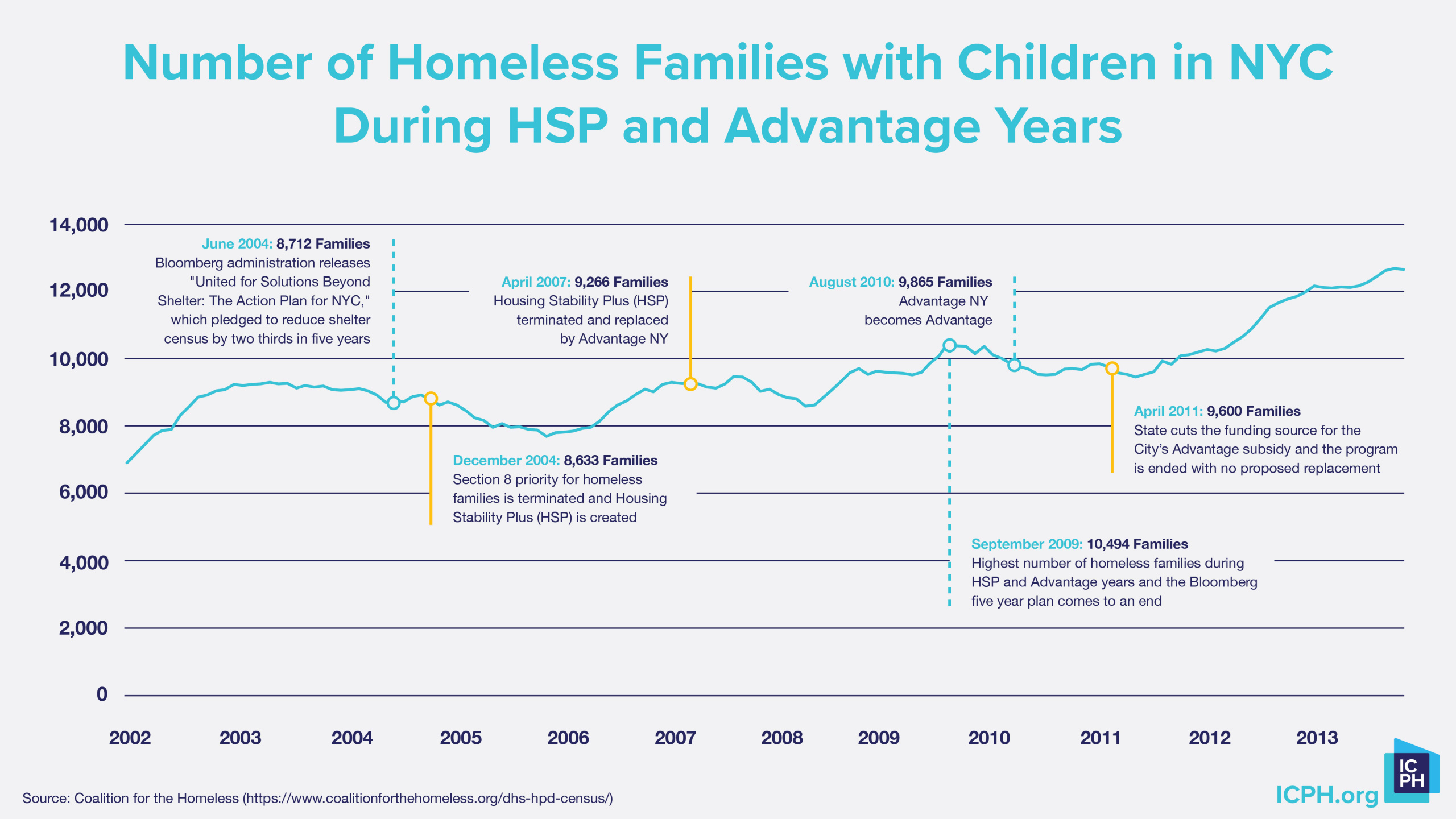
Past NYC Rental Assistance Programs to Address Homelessness
Housing Stability Plus (HSP)
Advantage New York replaced a program called Housing Stability Plus (HSP).29 This earlier local subsidy was launched in 2004 during a period of unpredictability and general shortage of limited federal Section 8 vouchers,30,31 and after the Bloomberg mayoral administration ended priority access to Section 8 vouchers for those experiencing homelessness under the argument that such prioritization disincentivized households to hold on to stable housing.32,33 The subsidy had a five-year time limit, and its benefits declined by 20% each year in hopes of prompting self-sufficiency. To receive the HSP subsidy, a family had to receive public assistance, meaning if they earned too much to qualify for public assistance, they would suddenly lose their housing subsidy as well. This required families to try to strike a very delicate balance in terms of the amount they earned each year. The combination of the difficulty of providing for a family while striking this balance and the often unsound conditions of the housing into which families were placed, such as lack of necessities like heat or hot water or the presence of vermin, lead paint, and other hazards, contributed to the program’s short tenure and its replacement with Advantage in 2007.34 In early 2007, prior to HSP’s replacement, the number of families in NYC shelters reached 9,287, breaking all prior records since the City had started tracking the shelter census and illustrating HSP’s ineffectuality.35
What is the Current Outlook for Homeless Families and Rental Vouchers?
A pattern emerges when NYC’s local rental subsidy programs from the last 20 years are considered side by side. The shelter census during the tenure of these subsidies ebbed and flowed based on the availability of vouchers, changes to the programs, and termination of the programs. The two common threads that policy makers focused on were (1) requirements that encouraged “self-sufficiency” and (2) costs.
Today, we find ourselves at the nexus of exorbitant rent costs, high food prices, and expensive or often inaccessible childcare for parents who work outside of traditional 9-to-5 hours. Many shelter residents work at least one job and still cannot afford housing.36 These systemic pressures make support for families vital. However, aspects of subsidy programs meant to encourage “self-sufficiency,” such as time limits or annually declining assistance, seem to accomplish the opposite of their goal. Often, families end up back in shelter or in the precarious housing situations where they started. This mandated idea of “self-sufficiency” therefore appears more harmful than helpful.
Perhaps the answer is not instituting requirements that theoretically increase motivation but instead removing barriers and making achieving housing and economic security as simple as possible. From there, families could build up their resources and finances to reduce and eventually eliminate their need for rental assistance.
This proposed answer is not to say that vouchers should be an easy, permanent way to simply avoid the housing market. Vouchers, in most cases, should be temporary—but efforts to ensure they remain temporary should be focused on reforming the greater systems that cause the need for subsidies, rather than pushing out individual households that still need assistance. System reform is a lofty goal, and it will take time—meaning it is all the more important to ensure that vouchers are accessible and effective while we pursue it.
1. New York Office of the Comptroller. “Administration of the CityFHEPS Program for Department of Homeless Services Shelter Residents.” Report 2023-N-1. October 2024. https://www.osc.ny.gov/files/state-agencies/audits/pdf/sga-2025-23n1.pdf
2. New York City Council. “Committee on Finance – May 16, 2025.” Citymeetings.nyc, May 16, 2025. https://citymeetings.nyc/meetings/new-york-city-council/2025-05-16-1000-am-committee-on-finance/chapter/cityfheps-program-changes-and-cost-management/.
3. Spauster, Patrick. “City Cuts Key Incentive For Landlords to Take CityFHEPS Housing Vouchers.” City Limits, June 10, 2025. https://citylimits.org/city-cuts-key-incentive-for-landlords-to-take-cityfheps-housing-vouchers/.
4. Brand, David. “NYC to replace thousands of rental vouchers after federal program expires, but at a cost.” Gothamist, August 11, 2025. https://gothamist.com/news/nyc-to-replace-thousands-of-rental-vouchers-after-federal-program-expires-but-at-a-cost?utm_source=sfmc&utm_medium=nypr-email&utm_campaign=Newsletter+-+Early+Addition+-+20250811&utm_term=a+new+source+of+rental+assistance&utm_id=475930&sfmc_id=117011118&utm_content=2025811&nypr_member=Unknown.
5. Stark-Miller, Ethan. “NYC Mayor’s Race: Mamdani, Cuomo ramp up attacks on each other the heels of Adams exit.” amNY, September 29, 2025. https://www.amny.com/news/mamdani-cuomo-attack-each-other-adams-09292025/
6. New York Office of the Comptroller. “Administration of the CityFHEPS Program for Department of Homeless Services Shelter Residents.” Report 2023-N-1. October 2024. https://www.osc.ny.gov/files/state-agencies/audits/pdf/sga-2025-23n1.pdf
7. Spauster, Patrick. “City Cuts Key Incentive For Landlords to Take CityFHEPS Housing Vouchers.” City Limits, June 10, 2025. https://citylimits.org/city-cuts-key-incentive-for-landlords-to-take-cityfheps-housing-vouchers/.
8. New York Office of the Comptroller. “Administration of the CityFHEPS Program for Department of Homeless Services Shelter Residents.” Report 2023-N-1. October 2024. https://www.osc.ny.gov/files/state-agencies/audits/pdf/sga-2025-23n1.pdf
9. Mayor’s Office of Management and Budget. “The City of New York Preliminary Budget Fiscal Year 2025: Program to Eliminate the Gap (PEG).” January 2024. https://www.nyc.gov/assets/omb/downloads/pdf/peg1-24.pdf.
10. Spauster, Patrick. “City Cuts Key Incentive For Landlords to Take CityFHEPS Housing Vouchers.” City Limits, June 10, 2025. https://citylimits.org/city-cuts-key-incentive-for-landlords-to-take-cityfheps-housing-vouchers/.
11. Spauster, Patrick. “CityFHEPS Voucher Holders & Legal Aid Sue to Preserve Landlord Incentive.” City Limits, June 30, 2025. https://citylimits.org/cityfheps-voucher-holders-legal-aid-sue-to-preserve-landlord-incentive/.
12. Spauster, Patrick. “City Backtracks on CityFHEPs Voucher Incentive, Will Subject Rule Change to Public Review.” City Limits, August 21, 2025. https://citylimits.org/city-backtracks-on-cityfheps-voucher-incentive-will-subject-rule-change-to-public-review/?oref=csny_firstread_nl&utm_source=Sailthru&utm_medium=email&utm_campaign=CSNY%20First%20Read%20-%20August%2022%2C%202025&utm_term=newsletter_csny_firstread.
13. New York City Council. “Statement from a New York City Council Spokesperson on the State Appellate Division Ruling on CityFHEPS Reform Laws.” Press Releases, July 10, 2025. https://council.nyc.gov/press/2025/07/10/2920/
14. Honan, Katie. “Council Loses Lawsuit Over Housing Voucher Program Expansion.” The City, August 1, 2024. https://www.thecity.nyc/2024/08/01/city-council-loses-cityfheps-lawsuit/
15. Yi, Karen. “Adams administration must expand city-funded rental subsidies, appeals court says.” Gothamist, July 10, 2025. https://gothamist.com/news/adams-administration-must-expand-city-funded-rental-subsidies-appeals-court-says
16. Brand, David. “Mayor Adams’ administration proposes rent hike for people with NYC housing vouchers.” Gothamist, April 30, 2025. https://gothamist.com/news/mayor-adams-administration-proposes-rent-hike-for-people-with-nyc-housing-vouchers?utm_source=sfmc&utm_medium=nypr-email&utm_campaign=Gothamist+Daily+Newsletter&utm_term=https://gothamist.com/news/mayor-adams-administration-proposes-rent-hike-for-people-with-nyc-housing-vouchers&utm_id=443416&sfmc_id=117011118&utm_content=2025430&nypr_member=False.
17. City Meets, “Council Member Ayala Questions Commissioner Park about CityFHEPS Voucher Program Changes | Committee on Finance | New York City Council | May 16, 2025 | Citymeetings.nyc,” Citymeetings.nyc, 2025, https://citymeetings.nyc/meetings/new-york-city-council/2025-05-16-1000-am-committee-on-finance/chapter/council-member-ayala-questions-commissioner-park-about-cityfheps-voucher-program-changes/.
18. New York City Council “ Int 1372-2025”. https://legistar.council.nyc.gov/LegislationDetail.aspx?ID=7649346&GUID=35EB7E85-A4AF-4DDF-82F7-B97CF35A73E1&Options=&Search
19. Quinn, Christine C. “Stop Mayor Adams’ Rent Hike on Vulnerable Families.” amNY, June 2, 2025. https://www.amny.com/opinion/stop-mayor-adams-rent-hike-vulnerable-families/.
20. Stein, Samuel, Oksana Mironova, Debipriya Chatterjee, Jennifer Hinojosa, and Yvonne Peña. “The City’s Rent Hike Plan for Voucher Holders Will Backfire.” Community Service Society, October 6, 2025 https://www.cssny.org/news/entry/the-citys-rent-hike-plan-for-voucher-holders-will-backfire.
21. McKinney, Latonia and Crystal Coston. “Hearing on the Mayor’s Fiscal Year 2012 Preliminary Budget & the Fiscal Year 2011 Preliminary Mayor’s Management Report: Finance Division Briefing Paper on the Department of Homeless Services.” New York City Council, Finance Division, March 2011, 22. https://council.nyc.gov/budget/wp-content/uploads/sites/54/2011/07/fy2012-dhs_071.pdf.
22. “News: New rental strategy rewards work and prepares clients for independent living through matched savings.” NYC Department of Homelessness, Internet Archive, accessed July 3, 2025. https://web.archive.org/web/20151215161425/http:/www.nyc.gov/html/dhs/html/communications/pr042507.shtml.
23. Asher, Colin. “Mayor Bloomberg’s Silver Bullet Misses the Target.” UNCENSORED (ICPH), Vol. 2.2, June 17, 2011. https://www.icph.org/uncensored/vol-2-2-summer-2011/#mayor-bloomberg-s-silver-bullet-misses-the-target.
24. NYU Furman Center. “Directory of NYC Housing Programs: Advantage.” CoreData.nyc. Accessed July 12, 2025. https://furmancenter.org/coredata/directory/entry/advantage.
25. Asher, Colin. “Mayor Bloomberg’s Silver Bullet Misses the Target.” UNCENSORED (ICPH), Vol. 2.2, June 17, 2011. https://www.icph.org/uncensored/vol-2-2-summer-2011/#mayor-bloomberg-s-silver-bullet-misses-the-target.
26. Iosso, Caroline and Max Rein. “Family Homelessness in New York City: What the Adams Administration Can Learn From Previous Mayoralties.” Institute for Children, Poverty & Homelessness, March 2022. https://www.icph.org/reports/what-we-can-learn-about-family-homelessness-from-the-last-six-mayoral-administrations/#introduction.
27. Coalition for the Homeless. “Number of People Sleeping in DHS and HPD Shelters Each Night.” https://www.coalitionforthehomeless.org/dhs-hpd-census/.
28. Markee, Patrick. “The Revolving Door Keeps Spinning: New Data Shows that Half of “Advantage” Families Have Returned to the NYC Homeless Shelter System.” Coalition for the Homeless, December 28, 2013. https://www.coalitionforthehomeless.org/uploads/2014/01/BriefingRevolvingDoorKeepsSpinning2013.pdf.
29. Asher, Colin. “Mayor Bloomberg’s Silver Bullet Misses the Target.” UNCENSORED (ICPH), Vol. 2.2, June 17, 2011. https://www.icph.org/uncensored/vol-2-2-summer-2011/#mayor-bloomberg-s-silver-bullet-misses-the-target.
30. “News: New rental strategy rewards work and prepares clients for independent living through matched savings.” NYC Department of Homelessness, Internet Archive, accessed July 3, 2025. https://web.archive.org/web/20151215161425/http:/www.nyc.gov/html/dhs/html/communications/pr042507.shtml.
31. Jonas, Jillian. Gotham Gazette. Accessed July 29, 2025. https://www.gothamgazette.com/disorderer/376.
32. The Office of the Mayor. “Uniting for Solutions Beyond Shelter: The Action Plan for New York City.” The City of New York, p. 34. Accessed July 29, 2025. https://www.nyc.gov/html/endinghomelessness/downloads/pdf/actionbooklet.pdf.
33. Jones, David R. “The Homeless – Out of Sight, Out of Our Thoughts.” Community Service Society. December 26, 2013. https://www.cssny.org/news/entry/the-homeless-out-of-sight-out-of-our-thoughts.
34. Asher, Colin. “Mayor Bloomberg’s Silver Bullet Misses the Target.” UNCENSORED (ICPH), Vol. 2.2, June 17, 2011. https://www.icph.org/uncensored/vol-2-2-summer-2011/#mayor-bloomberg-s-silver-bullet-misses-the-target.
35. Lee, Trymaine. “Homeless Families in City Shelters Hit Record, Despite the Mayor’s Efforts.” The New York Times, March 8, 2007. https://www.nytimes.com/2007/03/08/nyregion/08homeless.html.
36. Shapiro, Eliza. “When They Go Home After Working All Day, It’s Not to a Home.” The New York Times, April 8, 2025. https://www.nytimes.com/2025/04/08/nyregion/homeless-shelters-new-york-city.html