Introduction
New York State first granted New York City permission to spend the City’s own money to aid people experiencing homelessness 140 years ago in June 1886 when the State passed a law allowing New York City to establish a municipal lodging house—the city’s first public shelter. The shelter housed mostly men (800 beds were allotted for them) but also some women with their children and, in later years, whole families, until its closure in 1949.1 The 164 beds set aside for women and children represent the first time the City provided shelter for this demographic.2
New York City was tasked with covering all capital and operational costs with no assistance from New York State, while being beholden to state regulation, starting a long history of policymakers and observers questioning the appropriate share of the cost burden of public assistance to be carried by the City and State, respectively.3
As decades of policy have demonstrated, New York City alone cannot solve the problem of family homelessness: It will require coordination with New York State. The governor and New York State legislature have tools—such as legal discretion and deeper budgetary pockets to take such actions as increasing housing voucher amounts and allocating funds for the construction of supportive housing—that must be wielded in order to drive down homelessness, especially in the modern age.”4
New York City may be the Big Apple, but it operates at the pleasure of the Empire State—a fact that every mayoral administration is starkly reminded of each year on Tin Cup Day, officially called the Joint Legislative Budget Hearing—Local Government, that takes place when they visit the legislature in Albany to seek funding as part of the annual budget process.
This report examines how New York State has coordinated with New York City on the issue of family homelessness. We analyze the role of the State and its chief executive in helping to manage the family homelessness crisis since the mid-1970s with some attention paid to state efforts concerning other homeless populations when relevant to policies affecting homeless families with children.
A report issued in July 2026 by the New York State Comptroller’s Office noted that homelessness dropped by nearly 8 percent from 2024 to 2025, however, it rose in 68% of the state’s Continuum of Care regions, which serve as designated regions for planning, coordinating, and funding homeless services. While New York City was not among the areas of growth, the increases in such counties outside New York City where local resources are far less abundant and the Right to Shelter is not recognized—Columbia, Greene, Troy, Rensselaer, Schenectady—make the state take pause and acknowledge that the crisis is no longer confined to the five boroughs. Notably, children make up 32% of persons experiencing homelessness in New York State, which is double the recorded share in the rest of the country per the Annual Homeless Assessment Report (AHAR) to Congress. In announcing the report’s release NYS Comptroller Thomas P. DiNapoli plainly stated, “The problem is widespread and it is not confined to major cities. In particular, the public, private, and nonprofit sectors need to work together to address the crisis of so many children experiencing homelessness in New York.”5
Since 1975 New York State has had seven governors—some with lengthy tenures others with short ones—but all consequential to the last 50-plus years of family homelessness policy through the use of or disregard for three mechanisms, which the state has used to influence New York City’s approach to family homelessness:
- Policy agenda-setting from the governor (often in the State of the State or executive budget address) or legislature (in the form of bills introduced)
- Budgetary decisions made by the legislature and governor (adding or withdrawing funds that ameliorate homelessness)
- Administrative regulations issued by gubernatorial cabinet-level departments, such as the Office of Temporary or Disability Assistance (OTDA)
Follow the Money
It is perhaps of little surprise that decisions around increasing or decreasing spending on family homelessness are among the most contentious for policymakers. For over a decade, the New York City Independent Budget Office has been tracking the shifting cost-sharing for NYC’s main shelter system, overseen by the Department of Homeless Services (DHS).6 Different levels of government foot the bill for shelter costs for different DHS system populations, whether single adults, adult families, or families with children. Non-DHS shelters for youth, domestic violence survivors, and several other subpopulations are served by yet other funding streams and City agencies.7 In particular, state spending on shelter has significantly dropped over the last 10-plus years. While federal public assistance dollars such as the block-granted Temporary Aid to Needy Families (TANF) program fund a portion of shelter costs for many homeless families, New York State determines what the exact split will be.8 Families who receive TANF (or public assistance) receive it in two parts: (1) a general disbursement for basic daily needs and (2) a “shelter allowance,” more simply thought of as a housing allowance. When a recipient family enters shelter and is no longer paying rent to a landlord, state regulations permit New York City to claim the family’s official “shelter allowance” and apply it to the cost of that family’s stay at a DHS shelter.9
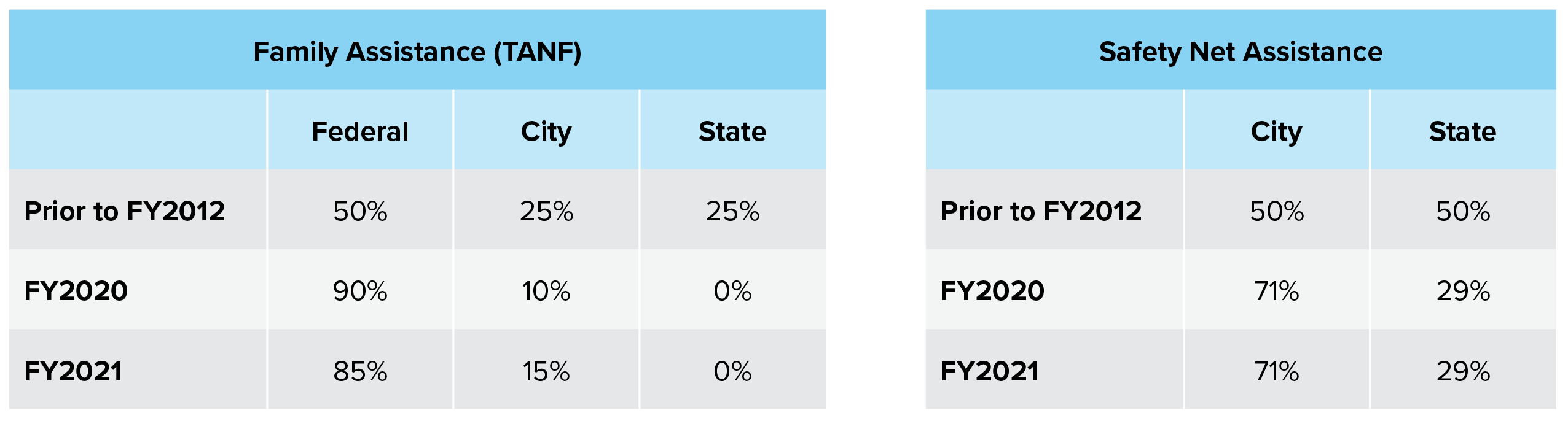
The City’s share of funding for family shelter and homeless services has grown overall, particularly Safety Net Assistance (granted to families timed-out of or ineligible for TANF). Cost sharing for family shelter has changed dramatically in the last decade and a half:
Figure 1 Change in Cost Sharing for NYC Family Shelter Pre-FY2012 TO FY2021
The Department of Homeless Services’ family shelter expenses in the New York City Adopted Budgets for FY25 and FY26 and the Preliminary Plan for FY27 show a similar trend of minimal state spending compared to federal and city outlays. Notably, the FY27 Preliminary Plan anticipates reduced federal social services commitments—on account of Congressional cuts—that necessitate increased City dollars devoted to family shelter.
The overall FY26 Adopted, FY26 Modified, and FY27 Adopted DHS budgets for all DHS populations served reflect an even starker financial arrangement.
The State makes minor contributions to non-family programs via (1) a state grant (covering 50 percent of adult shelter costs until an annual “adult shelter cap” is reached) and (2) federal block funds (Emergency Solutions Grant and Community Development Block Grant).10,11
Figure 2 NYC Family Shelter Funding FY2025, FY2026, and FY2027 Preliminary Plan
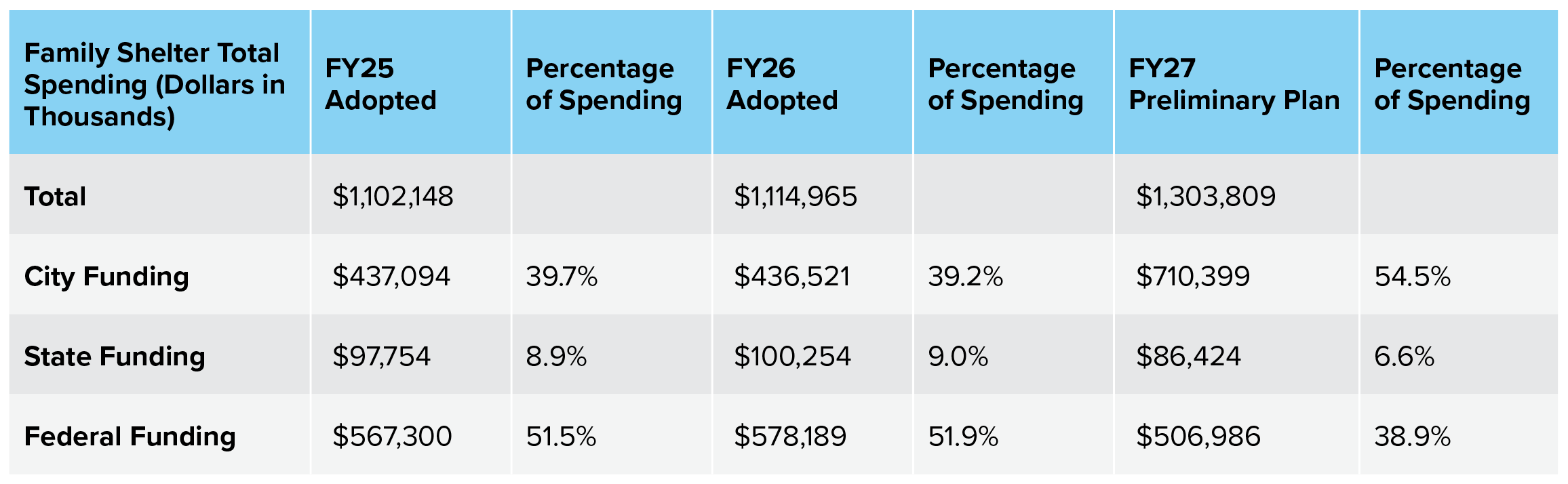
Source: https://council.nyc.gov/budget/wp-content/uploads/sites/54/2026/03/Department-of-Homeless-Services.pdf. Includes the three program areas of Family Shelter Administration and Support, Family Shelter Intake and Placement, Family Shelter Operations.
Figure 3 Overall NYC Shelter Services Funding FY2025, FY2026, and FY2027
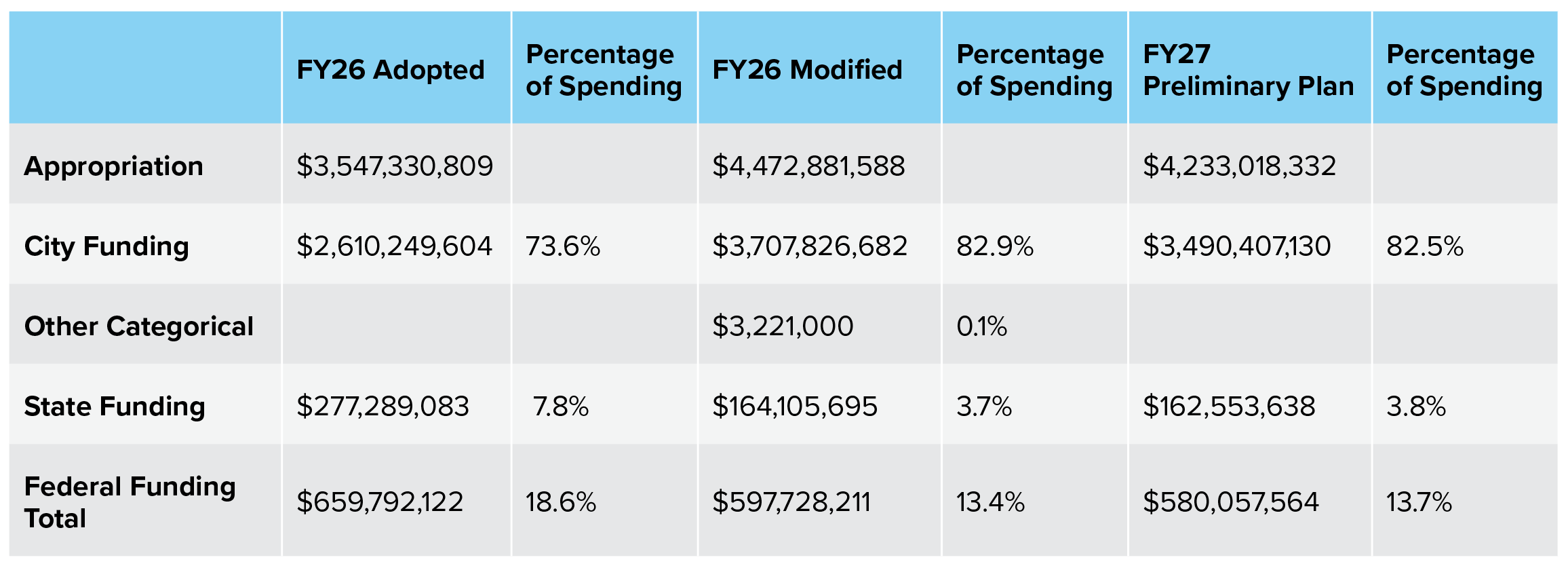
Source: https://www.nyc.gov/assets/omb/downloads/pdf/adopt26/erc6-26.pdf.
Seven Governors and Family Homelessness Policy
Hugh Leo Carey Administrations
1975–1983; two terms

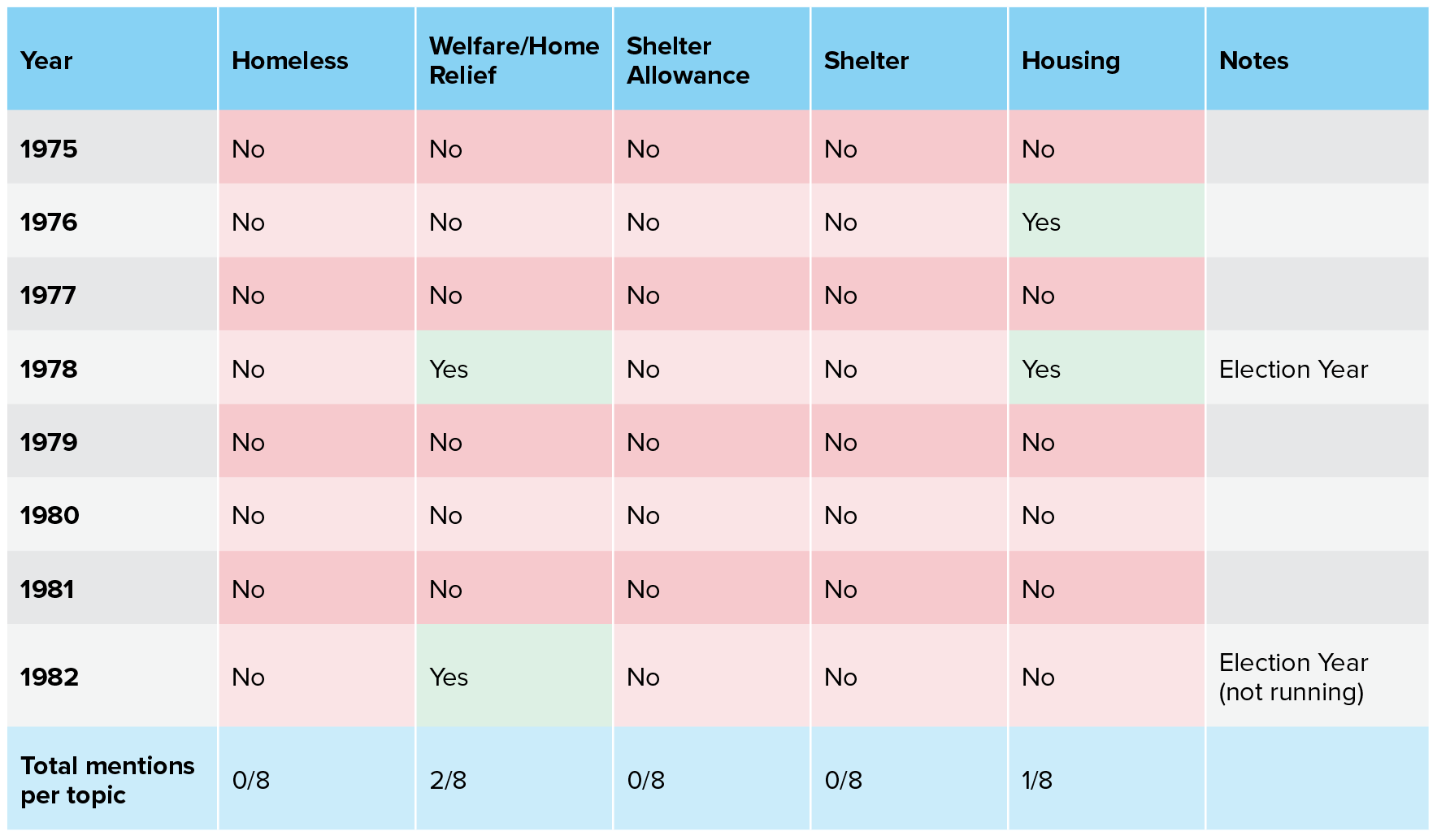
State of the State Messages Mentions of Issues Related to Homelessness
Context: New York City’s Modern Family Shelter System Takes Shape
To understand New York City’s modern family shelter system, it is necessary to look back to the 1970s with public policies and advocacy efforts focused on single homeless men and subsequent court cases that would influence New York City’s “right to shelter.” During Hugh Leo Carey’s first year as governor, New York City was on the verge of bankruptcy.12 In Albany, Carey had to deal with multiple converging local, state, and national crises. Under his leadership the relationship between New York City and New York State fundamentally changed, with the State acting as financial guardian for the City, determining nearly every fiscal move it would make.13
Governor Carey won reelection in 1978. In October 1979, the first year of Carey’s second term, Robert Hayes, a pro bono attorney with the Legal Aid Society, filed a class action lawsuit on behalf of all homeless men in New York City against both New York City and New York State in New York State Supreme Court.14 The Callahan in Callahan v. Carey (1981) referred to another Robert—Robert Callahan, a man living with chronic alcoholism on the Bowery, a neighborhood in lower Manhattan north of the Brooklyn Bridge, which, starting in the 1940s, became the epicenter (or Skid Row) of New York City’s street homelessness crisis.15 As state governor Carey received top billing, however, New York City Mayor Ed Koch was also listed as a defendant.
The First Right to Shelter Case: Callahan v. Carey
The lawsuit follows a strategy deconstructed in a 1982 Coalition for the Homeless16 report, Litigation in Advocacy for the Homeless, which determined that “creative interpretation of a more general statutory and constitutional language” would be the most likely path to obtaining a right to shelter.17 Hayes pointed to sections of the New York State Constitution, equal protection clause of the US Constitution, and New York State Municipal and Social Service law.18 The key phrasing often quoted as affirming the right to shelter is in Article 17 of the New York State Constitution: “‘The aid, care, and support of the needy are public concerns and shall be provided by the state and by such of its subdivisions, and in such manner and by such means, as the legislature may from time to time determine.’”19 The Callahan legal team made a big bet that a court would find this sentence proof of the right of men experiencing homelessness to have shelter provided to them by the state and city.
Several key court decisions preceded the filing of Callahan v. Carey, giving it wings. For example, 1977’s Tucker v. Toya determined that the state has “‘an affirmative duty’” to aid the needy and the legislature can define who is “needy” and has great latitude in determining how much assistance to provide. However, once they have “classified as needy” certain groups of persons, the New York State Constitution, “‘unequivocally prevents the legislature from simply refusing to aid them.’”20
In large part, the Callahan decision resulted in the City being responsible for providing clean shelter because, as Thomas Main contends in his book Homelessness in New York City: Policymaking from Koch to de Blasio, the City had a concrete history of providing shelter.21 The courts merely reinforced it.
One example of evidence of the City’s longstanding commitment to providing shelter can be found in a New York Times article on a 1964 budget request by NYC Welfare Commissioner James R. Dumpson. The New York Times notes that, “The official responsibility of the Welfare Department, as defined in its budget, is to “‘provide financial, medical and other assistance to persons in need; to aid persons in their return to self-support; to provide for homeless adults; to care for neglected and dependent children; to provide emergency or disaster assistance to the city’” [emphasis by ICPH].22
Additional examples of the City affirmatively providing shelter to persons and families in need will, several years later, come into play with the family Right to Shelter case, McCain vs. Koch.
A decade before he was to find his name on the defendant side of this and several other seminal lawsuits related to homelessness, Edward I. Koch was a US Representative for Manhattan’s 17th and, after redistricting, 18th districts railing against the horrors of the welfare hotels. Several entries in the Congressional Record23 as well as media reports have Koch assailing the City for mismanagement of the hotel crisis in the early 1970s. Koch lambasted the Lindsay mayoral administration for “‘deliberately misleading the public’” when insisting that families had to be placed in hotels because the maximum monthly rent payment allowable for permanent housing for welfare recipients was too low ($200; $1,677 in 2026 dollars). Koch said that neither Washington nor Albany set such a rule and that any funding maximums were “of the City’s own making.”24 A decade later in 1982 when Koch was NYC mayor, Ken Murphy, assistant director of the NYC Human Resource Administration’s Crisis Intervention Services, told The New York Times, ‘We’ve always provided for families.”25 Another New York Times reporter would note six years later that, “New York City has put up families evicted from their homes or burned out in fires for decades.” However, “this system, developed for temporary emergencies, faltered in the early 1980’s, when a shortage of low-income housing began turning homelessness into a permanent emergency.”26
On August 26, 1981 the City signed the consent decree with all parties agreeing to an enforceable yet operational or de facto “right”—with the actual constitutional question unsettled27—to shelter for all homeless men who applied for it provided that the applicant qualified for New York State Home Relief or otherwise needed temporary shelter due to “‘physical, mental or social dysfunction.’”28 The decree also specified the bare minimum quality of allowable shelter, sometimes based on existing state law for other regulated social services such as adult homes.29 For example, in 1981 in accordance with the consent decree, the state provided the City with access to state armories to house homeless men.30 In later years, women and families with children would also be sheltered in these large barracks.
The agreement also required the State to reimburse the City for a portion of shelter costs in alignment with the terms of the New York Social Services Law.31 However, it did not “obligate the Legislature of the State of New York to appropriate funds” nor did it “prevent, limit or otherwise interfere with the authority of the Commissioner of the New York State Department of Social Services to enforce and carry out her duties.”32
The consent decree was a compromise for all parties. The Coalition’s attorney Hayes explained in an interview with Thomas Main that per New York State law, an “automatic stay” or pause in litigation is granted to any government entity when they appeal a judgement.33 Hayes said that each additional stay would add a year to the case, and he felt an urgency to make sure that shelter would be available for his clients. This state law granting the automatic stay (CPLR 5519(a)(1)) is still in effect and has been applied to other homelessness-related litigation, including the 2024 challenge by the New York City Council to compel Mayor Eric Adams to implement the package of laws passed that expanded the eligibility criteria for the CityFHEPS voucher.34 This lawsuit was settled in June 2026 as part of the FY27 NYC budget process.35
While Callahan reached its conclusion during the Carey Administration, McCain vs. Koch, the case establishing a similar Right to Shelter for families with children, isn’t filed until two years later in 1983—under a different governor, Mario Cuomo.
Public–Private Partnerships Dawn
The courtroom was not the only venue where homelessness policy was being made during the Carey years. As part of the executive budget released in January 1980 more than a year before the consent decree was signed, Carey offered legislation that would provide state financial assistance to nonprofits seeking to acquire and rehabilitate single-room occupancy (SROs) for homeless individuals; the bill also would have provided capital funds to local social service districts for the provision of shelter.36 The Special Needs Housing Act would not pass the Legislature until two years later in 1982.”37,38
In late December 1980 Carey’s administration issued a report, New York State’s versus New York City’s Record in Mental Health and Social Services seeking to lay blame for the homelessness crisis at the City’s feet. The report said that the City’s J-51 tax abatement policy incentivizing owners of SROs to convert the buildings to luxury housing was, “‘the single greatest cause of increased numbers of homeless’” and not, as the City claims, the deinstitutionalization of psychiatric patients from state hospitals—a practice the state said had ended.39
After a lengthy effort by Governor Carey and others, the Special Needs Housing Act passed in spring 1982,40 with the State Division of Housing and Community Renewal issuing the program’s first grant awards during the last weeks of Carey’s final term.41
The grants allowed nonprofit and local government agencies to purchase and upgrade SRO (single-room occupancy) buildings that would become homes with supportive services for individuals experiencing homelessness and mental illness. This investment would mark the beginning of state financial support for a variety of permanent housing projects for formerly homeless individuals and families.42
Nevertheless, despite these initiatives, in May 1982 with roughly half a year left in Carey’s final term, a lawsuit modeled after Callahan v. Carey was filed by Hayes of Coalition for the Homeless—with Mayor Koch cheering from the sidelines—on behalf of individuals who experienced homelessness after discharge from state-run mental health facilities. The intended goal was to compel the state to provide such persons upon their release with housing in “‘a residence less inappropriate than city streets or municipal shelters.’”43 Less than six months later the case was dismissed by Justice Richard W. Wallach of the State Supreme Court, who viewed the Legislature as the correct venue for resolving such issues.44 Wallach was the same judge overseeing the Callahan consent decree.45 On appeal in March 1984, Hayes and his clients won a unanimous ruling stating that they had the right to sue for appropriate housing arrangements.46 At the end of 1987, Legal Aid filed two related cases, Heard v. Cuomo against the State and Koskinas v. Boufford against the City. The court dismissed claims against the State but ruled that City hospitals are required to provide patients in psychiatric units with appropriate discharge planning that links them to housing, continued outpatient treatment, and other benefits.47
Standardizing Housing Assistance Benefits
Early in his first term Carey issued regulations that would peg housing assistance to location. Currently, Family Assistance in New York is divided into two buckets: non-shelter and shelter grant (or housing allowance). A family with children receives a shelter/housing allowance calculated by the regulator, the New York Office of Temporary and Disability Assistance (OTDA), according to their county of residence and household composition.48
However, this wasn’t always the case. Until 1969, public assistance grants, including the amount allotted for shelter, were individualized based on each family’s need. In May of that year the Legislature passed a flat grant meant to cover a family’s full rent and other needs. No special needs or quarterly grants for clothing would be issued. Additionally, half of the State support for NYC home relief (benefits for individuals not eligible for Aid to Families with Dependent Children, the precursor to TANF/Family Assistance) was eliminated.49 Then in 1975, Carey’s first year in office, the New York State Department of Social Services set a maximum shelter allowance (the amount of rent based on a statistical sample paid by 95% of households receiving aid) for each social service district in the state. This stayed in place until 1988 when the allowance was set at “the 65th percentile of rents paid by public assistance recipients.” This move did not help the situation; by 1990 over half of public assistance recipients were making rental payments in excess of their housing allowance for units that were often in poor condition. A court case, Jiggetts v. Grinker (1990) made clear that the state “had a statutory duty under Aid to Dependent Children (the precursor to Family Assistance) to establish shelter allowances that bear a reasonable relation to the cost of housing, and that ‘[a] schedule establishing assistance levels so low that it forces large numbers of families with dependent children into homelessness does not meet the statutory standard.’” The upshot of Jiggetts is that the State was required to harmonize the shelter allowance with actual housing costs.50
Significant Developments in Homelessness Policy During Carey’s Tenure
- Introduction of a geographically based, maximum shelter (housing) allowance for public assistance recipients.
- Callahan v. Carey filed and consent decree signed by all parties
- Special Needs Housing Act passed, the first major state investment in permanent housing for formerly homeless individuals
Mario M. Cuomo Administrations
1983–1995; three terms

State of the State Messages Mentions of Issues Related to Homelessness
Context: Prioritizing a Complex Problem
Mario M. Cuomo served as lieutenant governor under Governor Carey prior to serving as governor himself.
Hanging over both the Carey and Cuomo administrations was the lingering issue of deinstitutionalization of state mental hospitals that had begun in the 1950s—long before either of their terms in office—as well as the dearth of single-room occupancy (SRO) and other low-income housing due to various city polices.51 Both of these factors contributed to many adults lacking access to one or more essentials, such as appropriate housing, financial, social, or health supports, which in turn created growth in the street homelessness population.52 While the Koch administration invested in permanent housing for homeless families through the in rem program (moving tax-delinquent and dilapidated buildings into nonprofit hands), there was hesitancy around creating programs for additional categories of persons in need.53 The State was also concerned about litigation such as Klostermann v. Cuomo (1984), which would compel it to provide housing for discharged mental health patients.54
In Cuomo’s first budget summary as governor, he focused a subsection on “Caring for the Homeless.”55 Cuomo wrote:
“Of particular urgency—and a problem which must be reckoned with not only in this State, but across the nation—is the growing number of people living on the streets in many cities, vulnerable to the social and economic conditions around them. Few problems facing society today require such across-the-board integration and coordinated management by all levels of government, the private sector and voluntary and nonprofit organizations.”56
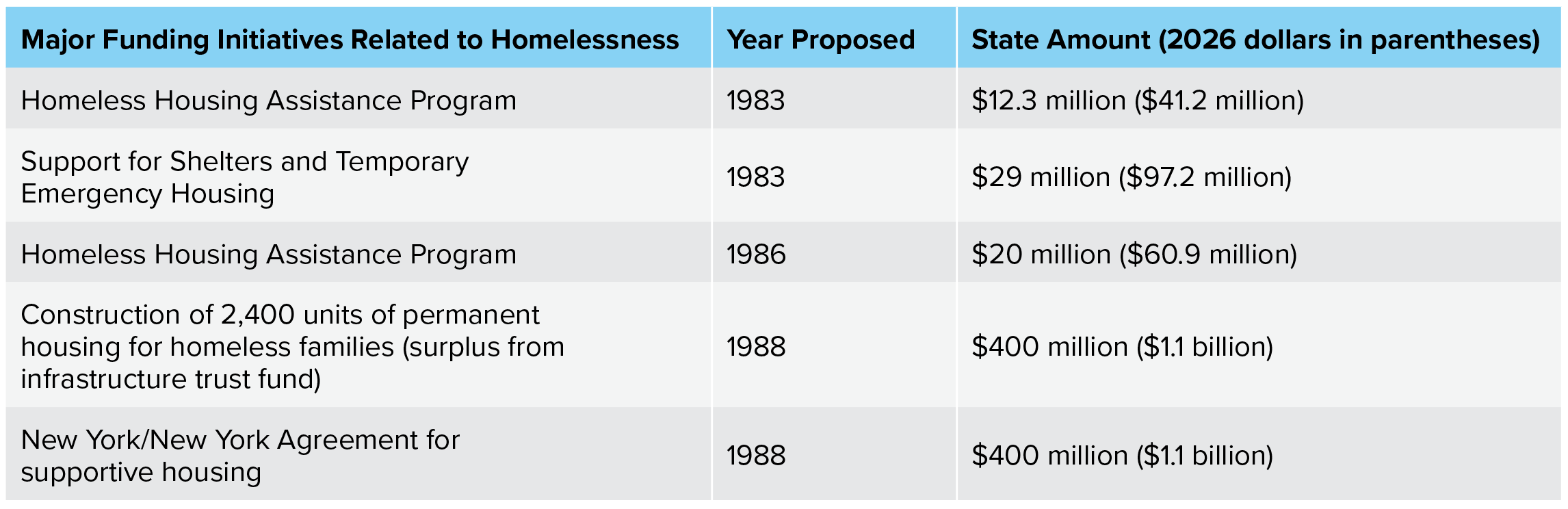
Cuomo went on to detail the $12.3 million in Homeless Housing and Assistance Program (HHAP) funds appropriated for the fiscal year along with $29 million to support shelters and temporary emergency housing, noting that the State was working to develop standards of “safety and adequacy” for hotels and motels used for emergency housing.57 Cuomo also supported efforts by the private and nonprofit sector to come up with innovative solutions to ease the crisis, which ultimately lead to the Tier II, non-congregate shelters for families still operating today.58
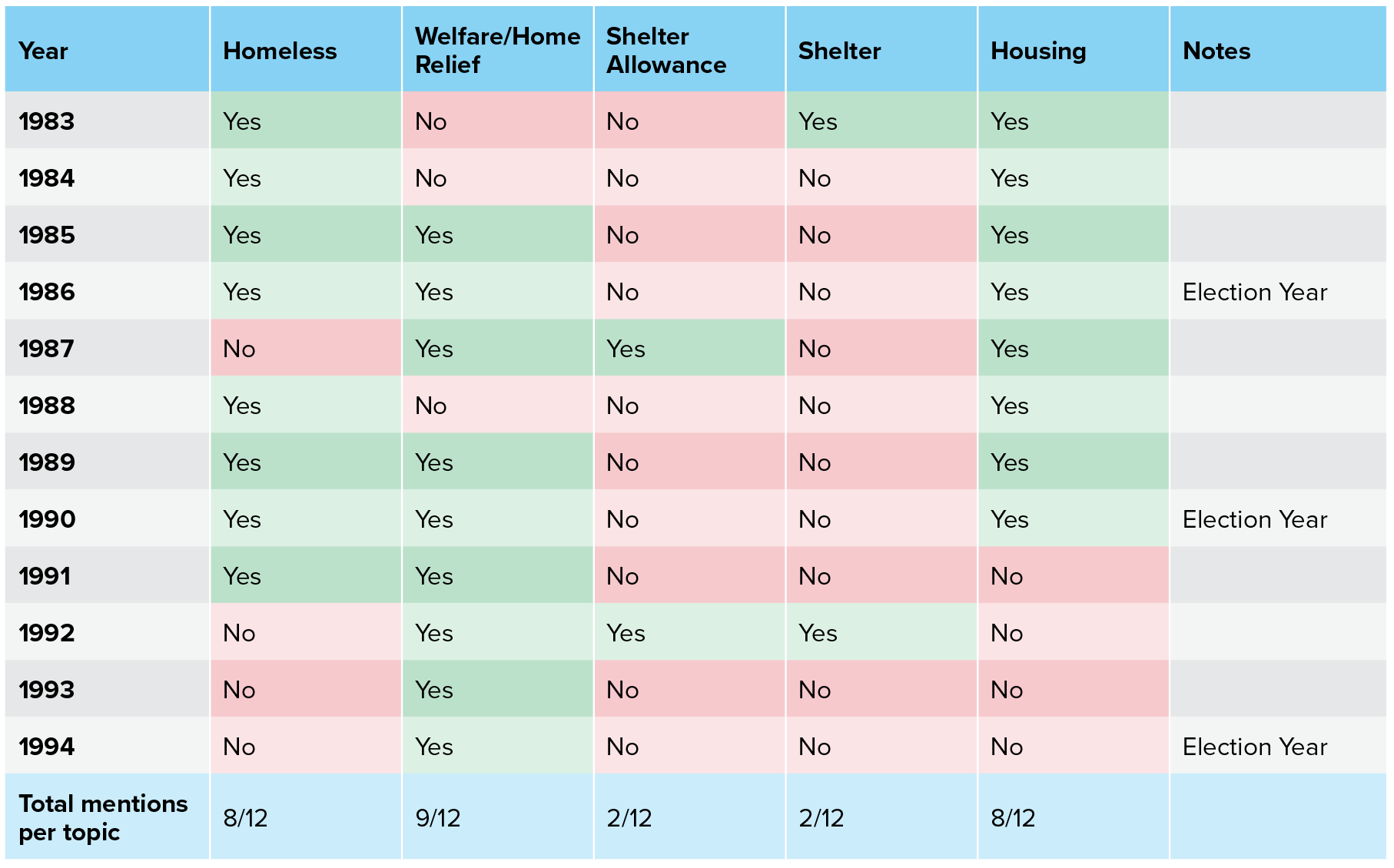
In April 1983 the New York Legislature passed and Cuomo signed HHAP into existence. It provided State-funded grants or loans for the acquisition, construction, or rehabilitation of housing for those currently experiencing homelessness or who would be homeless but for that housing.59 HHAP still functions today, and later in Cuomo’s governorship (1990) the State established the public Homeless Housing and Assistance Corporation to issue bonds to financially support HHAP projects.60 In 1985, Cuomo proposed a 45 percent increase for homeless services to include funding for emergency shelters, permanent housing, youth, mentally ill persons, and substance users.61 Cuomo discussed homelessness in eight of his 12 State of the State addresses—the highest percentage of any of the tracked governors.62 He also mentioned the issue in two out of the three years (1986 and 1990) when he was up for reelection (the 1994 State of the State—his last—did not mention homelessness).63
The 1986 speech included a pledge for another $20 million toward HHAP.64 In his 1988 State of the State Cuomo declared the “Decade of the Child” and proposed using a $400 million surplus from the infrastructure trust fund to construct 2,400 units of permanent housing for homeless families.65 And, in his 1990 budget briefing book, he highlighted the April 19, 1989 issuing of Executive Order 123, establishing the New York State Office for the Prevention of Domestic Violence and acknowledged that, “family violence is a major cause of homelessness among women and children”;66 his State of the State speech that year highlighted a new program for homeless individuals living with AIDS as well as plans to expand housing for mentally ill homeless persons.67
By this third term Mayor Koch was lamenting that the State wasn’t providing the City with any money for low-income housing.68 While this may have been the case at the time for family housing, and continued to be a problem for Koch’s successor, David N. Dinkins, who was denied funding for $12.4 million in rental arrears for approximately 32,000 families to prevent them from entering shelter,69 the City and State both contributed to fledging supportive housing for homeless individuals with mental illness. What started with a 55-unit project in Washington Heights in 1986, culminated in 1990’s New York/New York Agreement, the first intergovernmental agreement to create large numbers of supportive housing for this population. The goal was to create by June 30, 1992, over 3,300 units that could house 5,225 people at a joint cost of $194.7 million in capital funds.70
The New York/New York Agreement has been viewed by advocates as one of Cuomo’s greatest achievements in his many years as governor.71 They credit him for the 50,000+ units of supportive housing created statewide since that first agreement.72
Courts Weigh in on Family Homelessness
McCain v. Koch was filed by the Legal Aid Society on March 31, 1983 at the start of Cuomo’s first term using a legal strategy similar to that employed by the Callahan v. Carey plaintiffs around state and federal rights, although this time focusing on establishing a right to shelter “that met minimal standards” for families with children.73 By mid-June an interim order was issued with the state jumping to regulation, “with an eye to resolving the McCain litigation.”74 The standards for family hotels were incorporated into 18 NYCRR 352.3 (g)-(h) with close consultation with the plaintiffs whose prerogative was to have them mirror the standards of that of the nonprofit Henry Street Settlement’s Urban Family Center. The case ultimately was not easily resolved at that point due to a lack of compromise over the regulations and their enforcement.75
One incident early in Cuomo’s term perhaps illustrates the difficult relationship and lingering feelings from Koch’s victory over Cuomo in the 1977 mayoral race and Cuomo’s victory over Koch for the 1982 Democratic gubernatorial nomination. In 1983 the state began surprise inspections of welfare hotels. Numerous health violations were found as well as concerns raised that there was not enough food available to meet the needs of the many children living there. Cuomo ordered that food be sent to the hotels, but the state was stymied in its ability to respond due to lack of coordination among the relevant state, city, and private entities. Francis Tarlton, an exasperated State Health Department spokesman, told the New York Times, “‘We’re doing it the only way we can. We have to go through private organizations. We can’t cook food or provide food. We can coordinate.’”76
While the City was authorized to pay up to $41 a day to place a family in a hotel, the monthly shelter (housing) allowance rental ceiling for families receiving public assistance was $218 a month. Cuomo said that “‘an increase in the shelter allowance is certainly a valid subject of concern, which will be discussed in the context of next year’s budget.’”77
Cuomo soon thereafter announced his plan to increase, for the first time in nearly a decade, the shelter allowance by 25 percent.78 There was, however, a quirk in federal law that called for a decrease in food assistance dollars when the shelter/housing allowance increased, and Cuomo was trying to find a way around that via state-based nutrition funding.79 Koch also felt that any increase to the shelter/housing allowance should be fully covered by the state.80 Cuomo ultimately raised the shelter/housing allowance in 1984 and 1988.81
And so, the New York State Department of Social Services issued Administrative Directive 83 ADM-47 on September 29, 1983, which required local districts and state entities to assist homeless persons in finding housing immediately if found eligible. This move would prove pivotal to the ongoing McCain case, which at the time, no one could imagine would drag on for over two decades. The regulation incorporated wording from the interim order as well as several confusing phrases around eligibility for shelter and the length of waiting time for shelter that Main observed, “would have far-reaching implications for policy.”82
Concurrent with the McCain litigation, the Lamboy v. Gross case was making its way through the court system. On October 2, 1985, Justice Helene Freedman issued a preliminary injunction that blocked the City from placing families in Emergency Assistance Units (EAUs) instead of family shelter or a hotel/motel—something that was not exceptional but occurring regularly and violating the terms of family shelter the State laid out in 83 ADM-47.83 The Lamboy ruling was the first “to state explicitly that the city has an obligation, under a directive from the State Social Services Commissioner, to be the provider of last resort for all homeless families.”84 The City and State appealed the decision, with the State writing that stays in EAUs are permissible when, “‘good faith efforts to locate preferable alternative housing are unsuccessful.’”85
Bridging Three Mayors
In March 1986 an administrative directive, 86 ADM-7, advised that applicants needed to utilize “community resources, including friends and relatives” before seeking help from the local social service district. However, the local district had to ensure that those resources were “actually available” to the family to use.86
That month also saw the issuance of the Part 900 regulations, which eschewed congregate shelters in exchange for private units for families. They were finalized in July 1986.87
In May 1986 the McCain case inched closer to an interim conclusion, on the one hand with the Appellate Division of State Supreme Court unanimously ruling that families have a right to shelter and finding it likely that a right to shelter for families would be upheld on further appeal, but on the other hand, ruling that the minimal standards for quality of said shelter were not enforceable due to the NYS Constitution’s deference to the NYS Legislature in setting the level of benefits.88 In 1987, Lamboy v. Gross, McCain v. Koch, and another related case were consolidated and sent to Justice Helen Freedman who would preside over the question of shelter adequacy for decades.89
In Fall 1987 with a census of 3,800 families in 63 welfare hotels with a 13-month-long average length of stay, Koch announced a five-year city plan to end the use of welfare hotels for families in keeping in line with changing federal rules that would limit reimbursement after a family passed 30 days in residence, amounting to a $70 million cut.90 The plan “would propose construction of new housing, the conversion of existing hotels into shelters run by nonprofit groups, and programs to prevent families from becoming homeless.”91 Manhattan Borough President David Dinkins—who would go on to beat Koch in the 1989 mayoral election—suggested a similar policy—which Koch initially didn’t find compelling92— in his March 1987 report, A Shelter Is Not a Home: Report of the Manhattan Borough President’s Task Force on Housing for Homeless Families. As noted earlier, some of Dinkins’s homelessness polices were embraced by Cuomo and the State while others, such as payment of rental arrears, were not.
Koch tried to speed the rate of departure from hotels by opening new avenues to renovated housing units for homeless families through a complex shifting of resources, including those typically used by clients of other agencies, like Housing Preservation and Development (HPD).93 Despite these plans, the city was still using hotels in 1990—the City and New York State were sued when it was alleged that the City was placing families in welfare hotels noncompliant with State regulations.94
Surprisingly, on one of his last days in office in December 1994, Cuomo rescinded Administrative Directive 83 ADM-47—the regulation requiring the City to find housing for eligible homeless persons—and issued 94 ADM-20 (“Preventing Homelessness and Providing Assistance to Homeless Persons”), which permitted the city 48 hours to furnish assistance to a family and required the city to “make reasonable efforts to determine the applicant’s eligibility prior to providing temporary housing assistance.’”95 Some believed that the regulation was a parting favor Cuomo granted to then-Mayor Rudolph Giuliani (who defeated Dinkins in 1993 and took office in 1994) in exchange for the mayor’s support during Cuomo’s campaign against George Pataki.96
Significant Developments in Homelessness Policy During Mario Cuomo’s Tenure
- Homeless Housing and Assistance Program (HHAP) launched providing grants or loans for the acquisition, construction, or rehabilitation of housing for those currently experiencing homelessness or who would be homeless but for that housing
- ADM 83-47 issued requiring that shelter be provided to eligible persons experiencing homelessness
- Part 900 Regulations governing family shelter issued
- McCain v. Koch filed, and interim ruling reached providing for a right to shelter for families with children
- New York/New York Agreement for supportive housing signed
- ADM-94-20 issued giving NYC 48 hours to confirm eligibility for shelter
Will it be expensive? It will cost a fortune. (But) if government can’t take care of the homeless, the mentally ill, and the people who are addicted, what is government for?
– Mario Cuomo
George E. Pataki Administrations
1995–2007; three terms

State of the State Messages Mentions of Issues Related to Homelessness
Context
In November 1994, George E. Pataki, defeated three-term incumbent Mario Cuomo to become New York’s first Republican governor since Carey’s immediate predecessor, Nelson Rockefeller. Pataki stands out as New York’s only Republican governor during the period this report covers.
This was a time period of conservative social policy nationally. Even though U.S. President Bill Clinton was in office as a Democrat, he upended decades of the War on Poverty’s gains with his 1996 Welfare Reform. Rudolph Giuliani in City Hall and Pataki in Albany, both Republicans, were eager to implement the changes that would, as Clinton promised, “end welfare as we know it.”
In 1997 as states were developing reform implementation plans, NYC’s Independent Budget Office warned that, “certain social costs could be incurred if the State does not extend Home Relief assistance to those individuals dropped from the TANF rolls. The prospect of a substantially weakened social safety net for poor City residents increases the likelihood for higher costs in the future for, among other things, homeless shelters, foster care, criminal justice, and medical care.”97
A National Model’s Local Impact
The State received pushback from social service leadership in New York City and surrounding counties (Nassau, Suffolk, Westchester)—all led by Republican executives at the time—for reforms that were seen as detrimental to the fiscal health of their communities and the wellbeing of clients in their care.98 There was particular concern that limits on cash assistance could lead to increased homelessness, which in turn would create new financial burdens for the localities.99
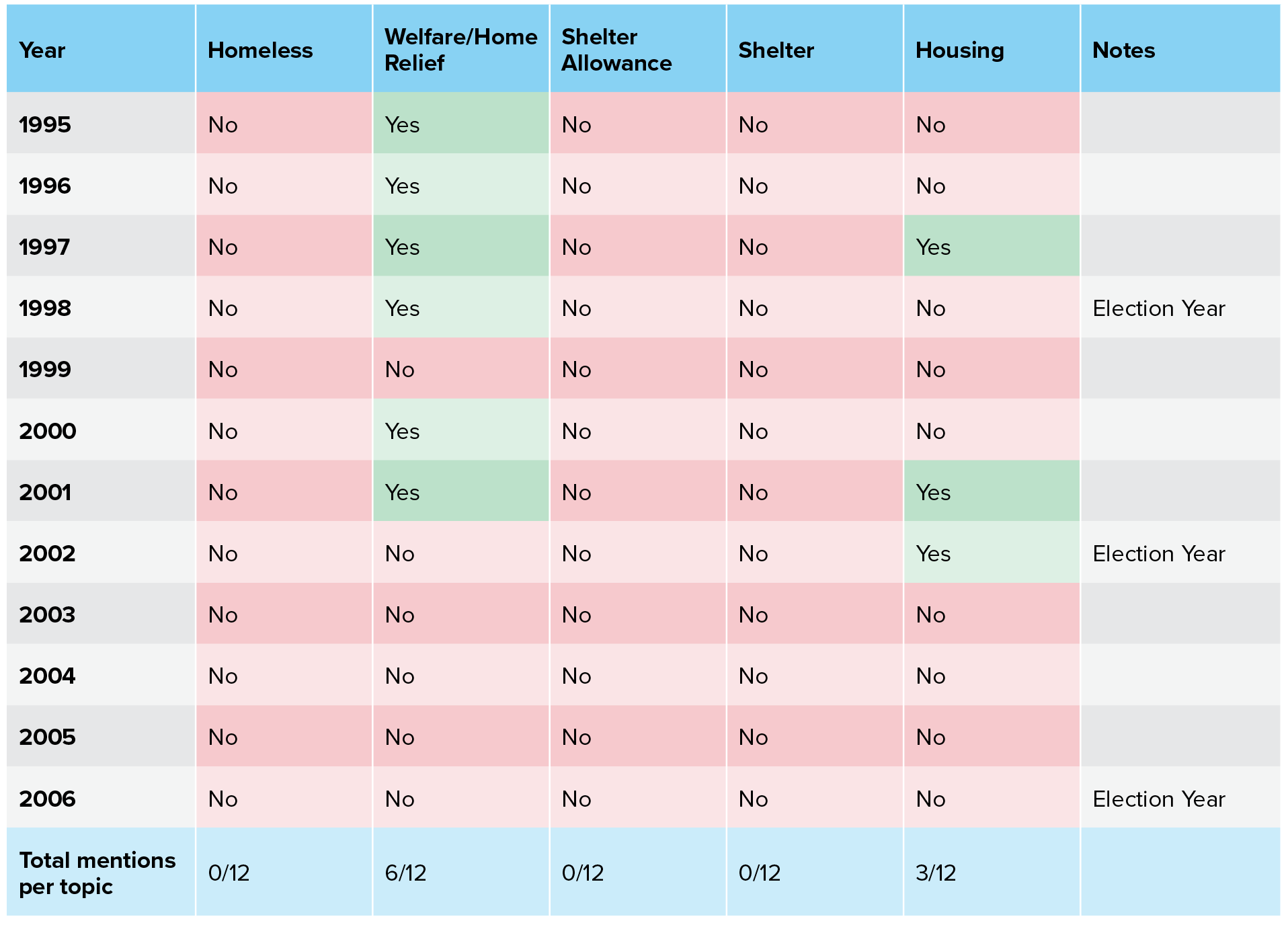
While welfare reform that followed the national move toward “self sufficiency” was a major concern for Pataki, the issue of homelessness on its own was never elevated and did not appear in a State of the State Address or mid-year budget update.100 However, while Pataki did not talk extensively about homelessness, his administration impacted the issue through targeted budgetary and regulatory decisions.
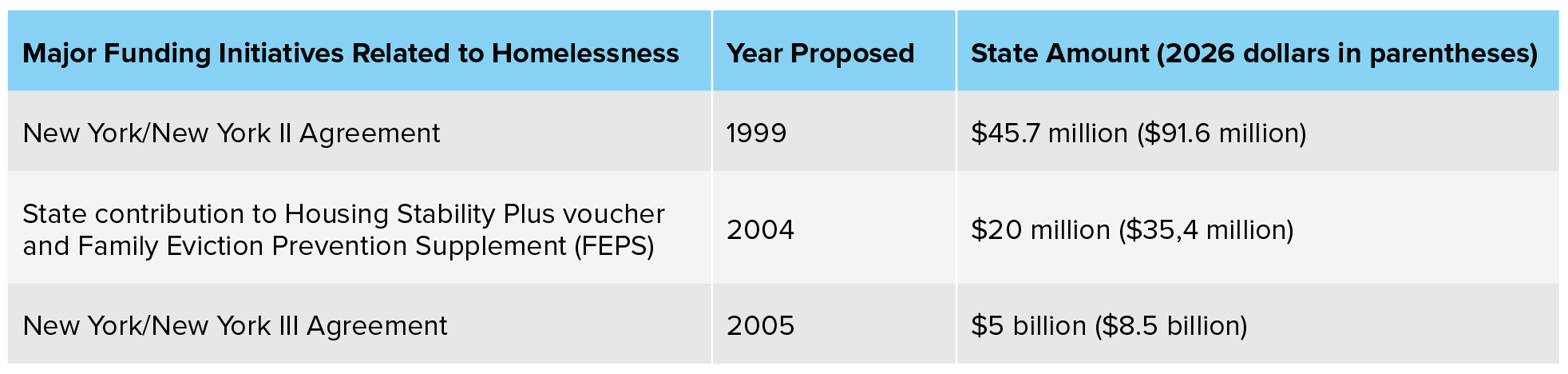
In April 1999 Pataki and Giuliani agreed to New York/New York II. The costs for 1,500 supportive housing units over five years were split $85 million city/$45.7 million state plus operating and service expenses paid by the state. Pataki had yet to be sold on the bang for the buck, so although advocates had pushed for 10,000 units, and Giuliani was willing to fund 2,500, everyone settled for what Pataki offered at the time.101
Pataki worked with the City to approve new forms of time-limited rental assistance for families facing eviction or exiting shelter.102 For families exiting shelter that was the Housing Stability Plus program with a five-year declining subsidy; for families facing eviction it was a five-year limited but non-declining grant (Family Eviction Prevention Supplement (FEPS)) that could serve approximately 3,000 families.103
In 2005, the city and state signed the New York/New York III Agreement, creating 9,000 units of supportive housing at a capital cost of $10 billion over ten years, evenly split between the City and State with operating expenses paid by the city and state agencies that were signatories to the agreement in accordance with the share of units apportioned to their clientele.104 It was a major accomplishment of intergovernmental collaboration, given Pataki’s previous ambivalence about supportive housing during the New York/New York II negotiations. And it expanded the pool of people who qualified for supportive housing beyond those with mental illness.
Shortly after Pataki’s election Giuliani asked Pataki to issue regulations to establish both eligibility determinations and independent living plans for families.105 It took some time and maneuvering around the courts, but at the end of 1996, the administrative rule was amended to place more responsibility on applicant families to prove their need for shelter.106
It was also in 1996 when “Eligibility for Temporary Housing Assistance for Homeless Persons” was added to New York State Social Services Law.107 Applicants had to agree to comply with Independent Living Plans (ILPs) and public assistance requirements around work-related activities; notably, they could be subject to child removal proceedings for noncompliance with their ILPs.108 Nearly 10 years later, a little-known interpretation of this section of the law would cause the City and State a brief but pounding headache when a policy requiring working shelter residents to pay a portion of their income for shelter surfaced (see the section on David Paterson).
For all his focus on welfare reform and a shift to self-sufficiency, it is perhaps ironic that Pataki bears the distinction of being the last governor to successfully raise the shelter (housing) allowance. It is considered subject to administrative rule review and needs to be reviewed by OTDA every five years.109 In 2003, “Temporary Assistance: New Shelter Allowances and Related Changes” was issued with the purpose of, “…provid[ing] a shelter allowance that reflects the cost of adequate housing for each district of the State…[and] reduc[ing] the incidence of serious housing problems, including homelessness.”110 The new levels were pegged to “the amount necessary to rent units that meet the housing standards used in the federal Housing and Urban Development’s (HUD’s) Section 8 program.”111 However, this positive development created complications around the existing court-ordered (by Jiggetts v. Grinker)112 “Jiggetts” eviction prevention supplement and introduction of the Family Eviction Prevention Supplement (FEPS).113
Pataki’s OTDA sought to limit applications to shelter through “Review of Reapplications for Temporary Housing Assistance” rules, which allowed DHS to deny shelter to applicants who had applied and been rejected within the past 90 days unless their circumstances had changed. Reapplications had jammed the system, and this directive helped relieve the pressure and allowed for the NYC Mayor Michael Bloomberg’s administration to pivot to prevention and diversion. Ten days of conditional shelter were offered to first-time PATH applicants.114
Pataki’s time in office was a relatively quiet one for the courts. Yet there was one minor, indirect development. In 2002 there was an opening on the New York State Court of Appeals that Pataki was required to fill. State Supreme Court Justice Helen Freedman, who oversaw McCain v. Koch and related litigation, was among the seven candidates that the State Commission on Judicial Nomination shortlisted for the position.115 Ultimately, she was not elevated to the role.116 But as will soon be discussed, it’s quite possible that her elevation by Governor David Paterson six years later changed the outcome of McCain v. Koch. And perhaps, if Pataki had made the same choice as Paterson, it would have led to a similar, yet speedier, settlement to the case, which was still dragging on.
Significant Developments in Homelessness Policy During Pataki’s Tenure
- New York/New York II Agreement
- New York/New York III Agreement
- Increase to the shelter (housing) allowance
- Phaseout of Jiggetts and rollout of Family Eviction Prevention Supplement (FEPS)
Pataki’s OTDA sought to limit applications to shelter through “Review of Reapplications for Temporary Housing Assistance” rules, which allowed DHS to deny shelter to applicants who had applied and been rejected within the past 90 days unless their circumstances had changed. Reapplications had jammed the system, and this directive helped relieve the pressure and allowed for the NYC Mayor Michael Bloomberg’s administration to pivot to prevention and diversion. Ten days of conditional shelter were offered to first-time PATH applicants.
Eliot Spitzer Administration
2007–2008


State of the State Messages Mentions of Issues Related to Homelessness

Context
Governor Eliot Spitzer came to power in Albany in the midst of Michael Bloomberg’s second term as New York City mayor. Three years prior, Bloomberg had released his five-year plan to reduce sheltered homelessness by two-thirds, “Uniting for Solutions Beyond Shelter: The Action Plan for NYC.” One of those solutions, the Housing Stability Plus voucher, was on its last legs, as was the old, notorious Emergency Assistance Unit.117
Housing, Not Homelessness
Spitzer gave two State of the States during his short tenure. Both touched on housing, a subject not unfamiliar to Spitzer as his father was a prominent real estate developer of mostly residential buildings.118 Spitzer’s 2007 address spoke about New York’s “twin challenges of high home prices Downstate and deteriorating housing stock Upstate.”119
Spitzer’s 2008 address, while again not mentioning homelessness, lamented the state of New York’s housing policy. “For over 100 years, New York led the nation with a progressive, visionary housing policy that helped to ensure that people had housing they could afford. In recent years, that vision dimmed.”120 He spoke of the “…millions of New York City residents…paying an unreasonable share of their incomes on rent” and highlighted the move over the last year to shift Housing Finance Agency funding toward “providing housing for working people,” tripling the production of affordable units to a total of 3,800 in 2007. Spitzer pledged that he would “propose the biggest housing initiative in a generation, a $400 million Housing Opportunity Fund.”121 Several weeks later, he officially announced that the fund, to be administered by the State of New York Mortgage Agency (SONYMA), would focus on production of housing for low- and moderate-income New Yorkers as well as those in need of supportive services with an advisory panel composed of representatives from multiple State agencies that served the likely clients. Three-quarters of the funding ($300 million) would be directed downstate.
Spitzer was only in office through one budget cycle but did make a significant addition to state spending in 2007. He expanded eligibility from 250 percent of the federal poverty line to 400 percent for Child Health Plus—a then decade-old health insurance plan targeted to families with incomes too high for Medicaid but too low for private health insurance.122 This move, along with a provision making enrollment in Medicaid less complex, essentially made it so every child in New York could theoretically have coverage. At the time, roughly 400,000 children were uninsured.123
Following a Suspicious Activity Report from his bank in Fall 2007, a federal investigation led to the uncovering of payments made for unseemly activities so scandalous that Spitzer could not remain in office.124 Spitzer tendered his resignation on March 11, 2008, effective March 17.
No Significant Developments in Homelessness Policy During Spitzer’s Tenure
David A. Paterson Administration
2008–2011


State of the State Messages Mentions of Issues Related to Homelessness
Context
David A. Paterson was serving as Spitzer’s lieutenant governor when he was elevated to the governor’s seat after Spitzer’s March 2008 resignation.125 Paterson had a tumultuous entry into the role compounded by the beginning of economic troubles for the state that even preceded the September 2008 financial crisis. Paterson called (in July 2008) for an emergency legislative session to be held in August 2008 to deal with fiscal matters.
On the heels of Spitzer’s resignation, it seemed as though Paterson would be able to move ahead with placing the $400 million Housing Opportunity Fund in the FY2009 State budget. However, the looming financial problems upended the expansiveness of those plans, with housing advocates anticipating the fund would be in the $200–$250-million range.126 Ultimately, the Enacted Budget included $100 million in “new off-budget spending for various housing programs, financed with funds swept127 from the State of New York Mortgage Agency (SONYMA),” which was considered “a new precedent” and continued in subsequent budget cycles.128
Courtroom Climax
Paterson’s term coincided with the climactic settlement, after 25 years in the courtroom, of McCain v. Koch on September 17, 2008.129 Perhaps Paterson’s most significant personnel move related to Justice Helen E. Freedman. Like Pataki, he also had to fill a vacancy on the State Appellate bench. However, Paterson did what Pataki did not and in late July 2008, promoted Justice Freedman to the Appellate Division, First Judicial Department, in Manhattan.130 Some argue that this “changed the dynamics” of the case.131 Whether directly or not, just a few months later in September 2008, the parties reached a settlement in McCain. Some observers, such as The Daily News, proclaimed that lead counsel Steven Banks was moved to resolve the litigation when he knew he would no longer be dealing with Justice Freedman, who had been viewed as consistently sympathetic to the plaintiffs’ arguments and likely to rule in their favor in the looming final outcome.132
The terms of the agreement were that the City recognized a “final, enforceable right to shelter for families and children” while retaining operational control over the shelter system free from interference from the courts.133 The shelter provided had to be adequate, meeting set quality standards, and both the City and State had to agree to due process hearings for families denied shelter or terminated from it.134 The case could only end by going to trial or reaching a settlement. The settlement was reached just before the trial was set to begin.
For its part the City was relieved to regain “full control and oversight of its family services system” and not have “to enforce over 40 highly-detailed court orders.”135
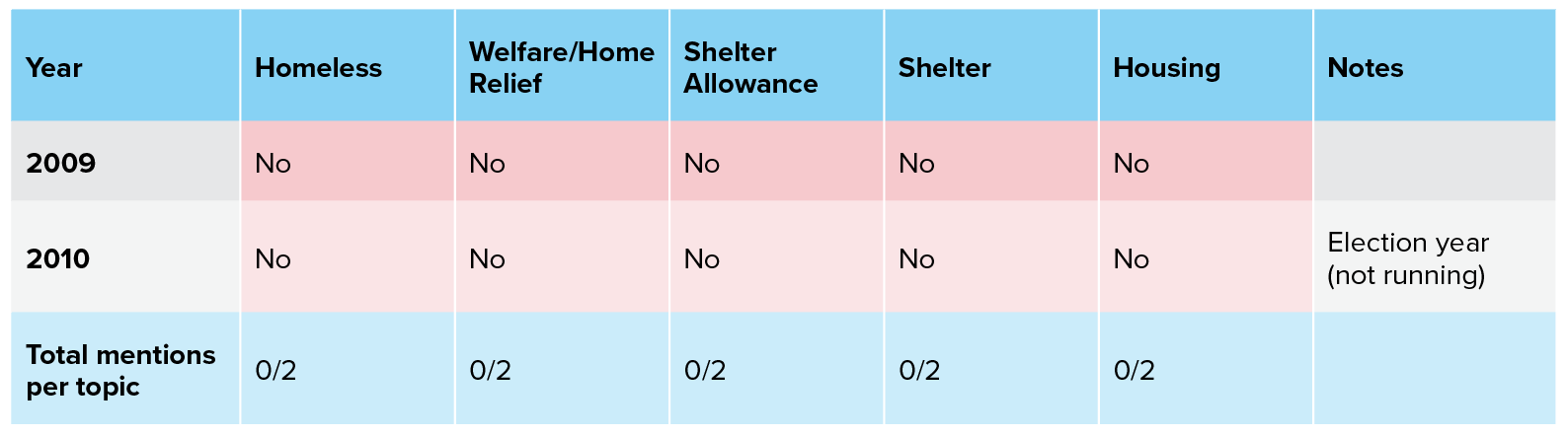
Following the settlement, Paterson gave two State of the State addresses and neither of them discussed homelessness, shelter, welfare, or housing. This is surprising given the state of the economy at that time, but perhaps an overall general focus on keeping the state afloat after the economy’s implosion, which greatly impacted Wall Street and tax receipts—as well as rancor over the distribution of federal Recovery Act funds136—kept Paterson from highlighting issues related to homelessness.
Low on Funds
From 2009 through 2011 OTDA issued 39 administrative directives.137 None of them pertained to family shelter. However, they opened the door to DHS’ ability to institute client responsibility and accountability measures, such as measures for working shelter residents to pay a portion of their income toward shelter. Advocates argued that the policy was counterproductive to having people save their earnings toward acquiring permanent housing, and the Legal Aid Society—which less than a year prior had settled the long running McCain v. Koch case with the City—threatened to sue.138 In June 2010, New York State legislators, Mayor Bloomberg, and Governor Paterson reached a deal swapping resident rent payments for savings plans.139
The City’s shelter census soared in lockstep with the fallout from the financial crisis, hitting a then-record high in December 2008 of 9,720 families.140 As a result of the economic situation, Paterson had to make some devastating cuts over several budget cycles.141 The budget for the Supportive Housing for Families and Young Adults (SHFYA) program, for one, was halved in the Fiscal Year 2011 budget.142 Paterson was able to save some programs (including Supplemental Homeless Intervention Supportive Housing for Families) by using the TANF Emergency Contingency Fund to replace State funds.143
Paterson had to give up hope of triumphantly leading New York out of the crisis. Following accusations of misconduct and abuse of power in a long-time aide’s criminal case, Paterson ultimately withdrew from the 2010 race for governor not long after he kicked off his campaign, paving the way for a predecessor’s son.144
Significant Developments in Homelessness Policy During Paterson’s Tenure
- McCain v. Koch settlement
- Controversy over collecting rent from working residents in shelter
Andrew Cuomo Administrations
2011–2021; three terms (completed two and part of third)


State of the State Messages Mentions of Issues Related to Homelessness
Context
Son of Governor Mario M. Cuomo, Andrew M. Cuomo followed his father into New York politics, serving as an advisor and eventual point person on homelessness for the elder Cuomo.
Amid a rising shelter census, in 1991 Mayor David Dinkins convened a group of experts on homelessness to provide a new direction for the City’s homelessness policy. The “Cuomo Commission,” as it came to be known, was headed by the younger Cuomo, then leader of the transitional housing organization Housing Enterprise for the Less Privileged (HELP USA), which he founded in 1986. Although Dinkins had initial success moving families from shelter to permanent housing in his first year in office (1990), families continued to enter homelessness due to high levels of poverty and unemployment that had lingered from the previous decade’s recession.145
The commission presented three key recommendations. It (1) encouraged a shift from Tier I emergency congregate shelters to service-rich, not-for-profit operators; (2) advised the creation of the Department of Homeless Services (DHS), a new City agency independent from the Human Resources Administration (HRA); and (3) advocated for an increase in homelessness prevention, largely through investing in rental subsidies.146
Following his commission leadership, Cuomo served as an assistant secretary of the U.S. Department of Housing and Urban Development (HUD) during President Bill Clinton’s first term. He developed the “Continuum of Care” strategy as well as the consolidated planning process for use of HUD funds in local communities. When the first federal law pertaining to homelessness—the Stewart B. McKinney Homeless Assistance Act of 1987—was passed it authorized HUD’s Office of Special Needs Assistance Programs to distribute, through a national competitive process, federal funds to meet the needs of individuals and families experiencing homelessness.147 However, the process was not coordinated at the local level, which led to siloed approaches in addressing the issue. Cuomo’s innovation was to require, beginning in 1994, a single Continuum of Care (CoC) application from a defined local community (municipality, county, etc.) with the goal of the single streamlined application being coordinated, inclusive, and reflective of the needs of different subpopulations (individuals, families, etc.) within a given community. Cuomo also championed programs focused on growing housing and employment opportunities that would lead to client self-sufficiency.148 In Clinton’s second term (1997–2001) he appointed Cuomo HUD secretary.149
Cuomo entered the fray during Bloomberg’s third term as mayor when the state was still suffering from the austerity budget necessitated from the fallout of the Great Recession.
City vs. State: Vouchers and Vendettas
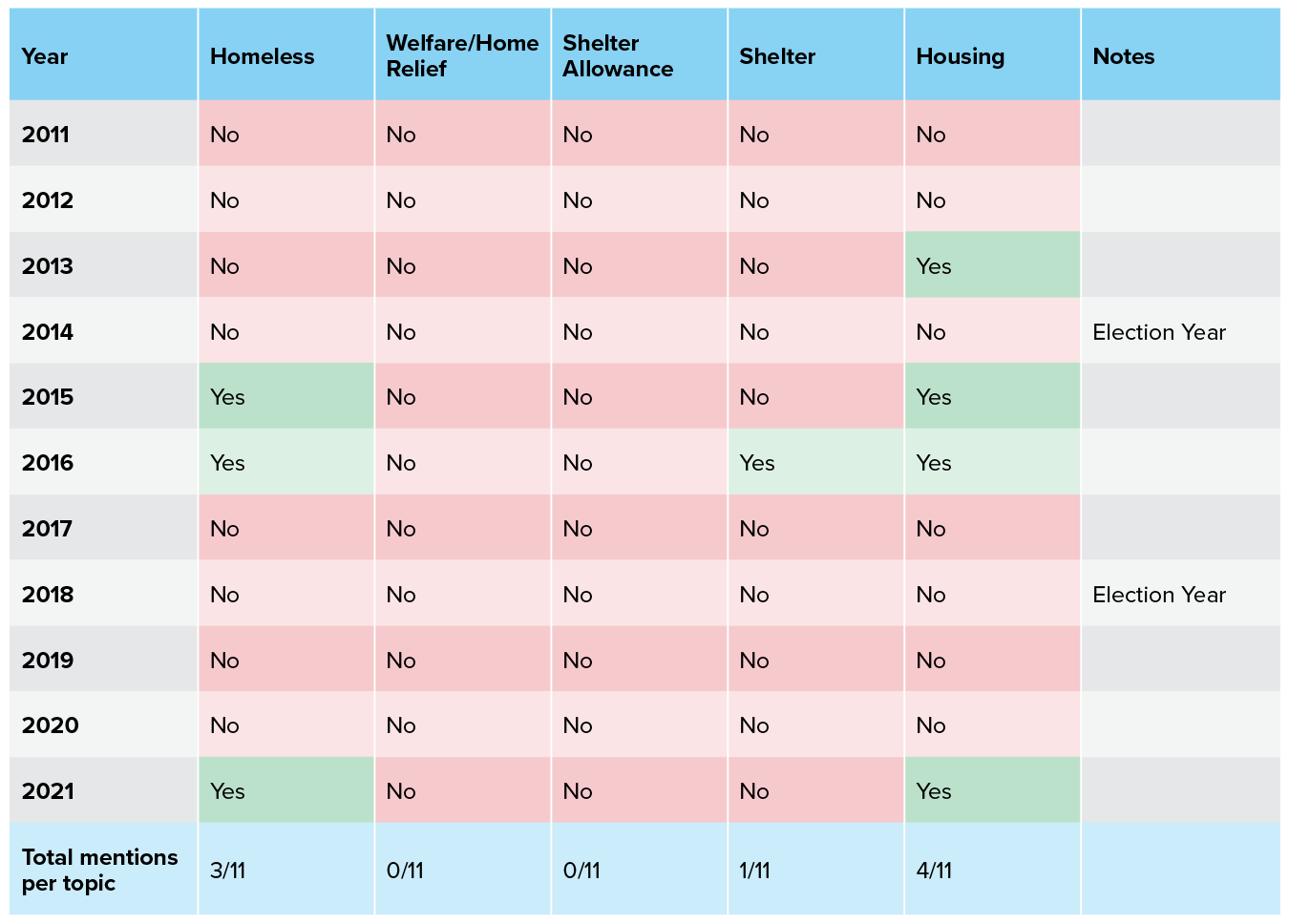
During his first term Cuomo was not proactively seeking to highlight homelessness or housing investments. When, as will be discussed below, budgetary issues made supporting certain programs—namely the Advantage housing voucher—unsustainable, he weighed in, but it was only after he entered his second term with the homeless census ballooning under adversary, New York City Mayor Bill de Blasio, that he decided to highlight his expertise and focus on this issue in his State of the State addresses—particularly in 2015 and 2016, notably after his 2014 reelection and far away from his 2018 bid.150
The Cuomo Administration also enacted a number of important policies to help people exit poverty. For example, in 2015 New York City and New York State coordinated—but not without conflict—an increase to the minimum wage.151
During Cuomo’s tenure he made some critical budgetary decisions that arguably influenced the NYC shelter census over two mayoral administrations. In fact, under Cuomo’s leadership, the state paid proportionally less for homeless services and required the City to foot more of the bill. The state’s share of spending on homelessness programs fell from 29 percent in 2010 before he assumed office to 15.6 percent by 2016.152
Mayor Michael Bloomberg launched the Advantage New York program in 2007. Advantage was a time-limited housing subsidy that gave families more money than its predecessor program Housing Stability Plus (HSP), but it expired after only two years and had strict income restrictions such that a family ran the risk of “falling off the benefits cliff” and losing the subsidy if a parent found a full-time job that brought their total income past 200 percent of the federal poverty line.153
In 2011 Cuomo was facing a $10 billion state budget gap, and he opted to cut spending instead of raising taxes. Included on the chopping block was the state’s $65 million contribution to the Advantage program, which also came with $27 million in matching federal funds.154
The Bloomberg administration did not find a way to make up the funding shortfall, forcing Bloomberg to end Advantage.155 At the time, Advantage was unpopular among advocates for the homeless due to its time limit and other shortcomings.156 Yet, because it was the only available support for individuals and families exiting shelter, its critics defended it once it was at risk.157
New York City’s homeless census ballooned. Many families whose Advantage voucher period ended reentered shelters, and many others confronting increasing unaffordability in housing flooded into the shelter system. Over three years, the shelter census grew by nearly 16,000 individuals, from 38,000 to over 53,000.158
Cuomo had a notoriously tumultuous working relationship with Mayor Bill de Blasio, who entered City Hall in 2013. The pair first worked together when Cuomo served as HUD secretary and de Blasio was HUD’s regional director for New York and New Jersey.159
Following the fallout from the end of the Advantage program, New York City created the Living in Communities (LINC) rental assistance program.”160 The state approved LINC I (for working families) and LINC II (“for families with recurring shelter stays”)161 in August 2014, and the program was launched September 2014.162 According to advocates, the State dragged its feet, delaying the LINC program until the fall when it could have launched sooner.163 Additionally, some families in shelter if they met certain criteria did have access to state eviction prevention subsidies that had evolved over the decades through litigation (Jiggetts, Family Eviction Prevention Supplement (FEPS),164 and Family Homelessness and Eviction Prevention Supplement (FHEPS)).
When the LINC rental assistance program was active (2014–2018), although the vouchers were mainly funded with city dollars, the State permitted the City to use any leftover (due to shelter census reductions) TANF or Safety Net funds earmarked for Family Shelter for LINC vouchers.165 In July 2018 the series of rental subsidies that grew out of LINC were consolidated into CityFHEPS (City Fighting Homelessness and Eviction Prevention Supplement). A recent report from New York City shelter and supportive housing provider WIN states that TANF funds are paying for a very minor percentage (less than 1% of total funding) of CityFHEPS vouchers—perhaps under the same as arrangement that permitted their use for LINC.166
In 2015 OTDA loosened eligibility rules.167 An administrative directive “Temporary Housing Assistance: Consolidation and Clarification of Policy” was issued cancelling the Pataki-era regulations and clarifying others.”168 The order expanded eligibility by making it easier for families in overcrowded housing conditions to be found eligible. It was much easier for the primary tenant of the applicant family’s last residence to say that the family couldn’t return there and needed shelter.169 As author Thomas Main observed, “Fiddling with the eligibility standards at the very time when the new rent-subsidy programs were supposed to drive the shelter census down was probably not a good idea.”170 Homeless numbers also went up outside New York City as the shelter allowance (public assistance housing allowance) failed to keep up with rising housing costs, and Cuomo and the legislature would not raise it.171
In sum, 43 administrative directives172 were issued, five fairly significant ones related to family shelter. Cuomo’s 2016 address zoomed in on shelter oversight, announcing that he would work with NYS Comptroller Thomas P. DiNapoli and NYC Comptroller Scott Stringer to more closely inspect and audit city shelters, threatening to close those with deficiencies.173 Cuomo stayed on this note in 2016, signaling that he intended to take a larger role in overseeing the city’s shelter system while also plainly stating that the city was funded by the state to the tune of hundreds of millions of dollars and NYC could therefore spend more of its own money on homeless services and rental assistance.174
Ahead of these announcements in his 2016 State of the State and executive budget release Cuomo was attacked by Assemblymember and Social Services Committee Chair Andrew Hevesi. Andrew Hevesi noted that only 14% of the cost of homeless shelters in NYC was being paid for by the state.175 Hevesi also called out Cuomo for cutting OTDA’s budget by 13 percent and enumerated a litany of funding cuts to homeless services, supportive housing, and housing assistance. Hevesi noted that the State was currently contributing nothing to the cost of sheltering TANF-recipient homeless families with children after previously paying 25 percent. Hevesi continued to explain that the cost of sheltering Safety Net-eligible families with children rose for the city due to a 44% cut between 2007 and 2014; the State was only paying 29 percent—it used to pay 50 percent—of the cost. And the percentage of adult shelter costs covered by the state fell to 21 percent from 47 percent. Among Hevesi’s other funding complaints:
- The State contributed only $5 million to the new Living in Communities (LINC) NYC rental subsidy program.
- Only $124.5 million of a total $7.9 billion in monetary settlements over the last two years were directed to supportive housing, and only $74.5 million to new supportive housing for families and individuals and $50 million to support existing supportive housing.176
Perhaps as a response to criticisms that he was reducing the State’s responsibility for services he had once advocated for, in 2016 Cuomo unveiled and in 2017 launched a five-year, $20 billion plan to create supportive housing, preserve and build affordable housing, and provide support to shelters.177 This was after he and de Blasio couldn’t agree on a New York/New York IV Agreement.178 In December 2019 just ahead of the pandemic, progress had been made on the affordable housing front, with 90 percent of the goal of 62,000 units completed or under construction met and funding approved for 6,000 supportive housing units.179 The share of funding for NYC shelters remained flat, because the $7.5 billion allocated to shelter over the covered fiscal years represented a commitment to maintaining then-current funding levels and not adding additional funds.180
The Cuomo administration continued introducing new shelter oversight regulations, such as the July 2017 administrative directive, Emergency Shelter Operating Budgets and Per Diem Rate Submissions.” This directive was concurrent with a New York State Comptroller audit on shelter payment rates.
Cuomo proposed in his FY19 executive budget a requirement that “New York City and other local governments develop, submit, and implement a plan to provide outreach and services to the homeless. If enacted, the city’s plan will be subject to approval from the state and the city will be required to submit progress reports on designated outcomes. The budget furthermore authorizes the state to withhold or delay funding payments to the city if the state determines that the efforts to meet the plan have been insufficient.”181
Finally, in late March 2020 during the height of the COVID-19 pandemic, Cuomo paused all evictions in the state through executive order. In December 2020, the eviction moratorium was signed into law by the New York State Legislature and stayed in place until January 2022.182 According to an analysis conducted by the New York City Comptroller’s Office, the overall shelter population dropped 25% between spring 2020 and 2022, with the lowest daily population in roughly ten years—44,586 individuals—recorded in August 2021. This drop was attributed to the combination of the state moratorium and other pandemic-era rental and income supports, such as the Emergency Rental Assistance Program (ERAP).183
Although passed in June 2021 while Cuomo was still in office, Kathy Hochul was the governor to sign Assembly Bill A8009, making the Family Homelessness and Eviction Prevention Supplement Program (FHEPS) vouchers equivalent to HUD’s fair market rent level.184
Like Spitzer before him, Cuomo would also prove to be his administration’s most influential shift in personnel as he was forced to resign in the middle of his third term due to harassment allegations.
Significant Developments in Homelessness Policy During Andrew Cuomo’s Tenure
- Defunds Advantage voucher program
- Loosens then retightens shelter eligibility rules
- Approves city plan for LINC and CityFHEPS vouchers
- Emergency Rental Assistance Program (ERAP)
- Eviction moratorium
Kathy Hochul Administration
2021–Present

State of the State Messages Mentions of Issues Related to Homelessness
Context
New York native Kathy Hochul was first elected Lieutenant Governor in 2014 when Cuomo’s first-term lieutenant governor, Robert Duffy, opted to retire. Reelected for a second term alongside Cuomo in his third, Hochul assumed the governor’s seat when Cuomo resigned in August 2021 due to harassment accusations.
Prior to Cuomo’s scandalous troubles he had been praised for his deft handling of 2020’s COVID-19 health crisis. Hochul stepped into the role when the worst of the crisis had abated but new variants were still circulating and economic fallout lingering. Less than a year after she took office, the asylum-seeker crisis emerged. Hundreds—and eventually thousands—of asylum seekers presenting at the U.S.–Mexico border in Texas made their way to New York, initially through buses sent by Texas Governor Greg Abbott.185 The city’s shelter system had shrunk during the height of COVID and quickly saw a rising census. NYS had a long history of providing assistance to newcomers that leaders were initially eager to uphold in 2022.
When Governor Nelson Rockefeller vetoed a 1960 bill aiming to cement a minimum period of residency before people could be eligible for welfare he wrote, “Over the years of great migration into our state, New York has steadfastly maintained its humane policy of erecting no residency bar as a requirement for public assistance or care.”186 Yet as discussed below, over sixty years later when confronted with the crisis, New York City Mayor Eric Adams and New York State Governor Hochul strained to agree with Rockefeller’s sentiment.
Housing Jumpstart and Stall
In 2021 Hochul signed Senate Bill S2755C, which established an advisory council charged with investigating ways to reduce child poverty by fifty percent within ten years.187 The Child Poverty Reduction Advisory Council launched in October 2022188 and issued their recommendations and progress report in December 2024.189 Chief among them were creating a state-level housing voucher similar to Section 8.190 As we will soon see, in the budget cycle that immediately followed the report’s release, the governor and legislature included a pilot program in line with that recommendation. Other recent state investments in child tax credits and childcare are also tied to the Advisory Council’s work.191
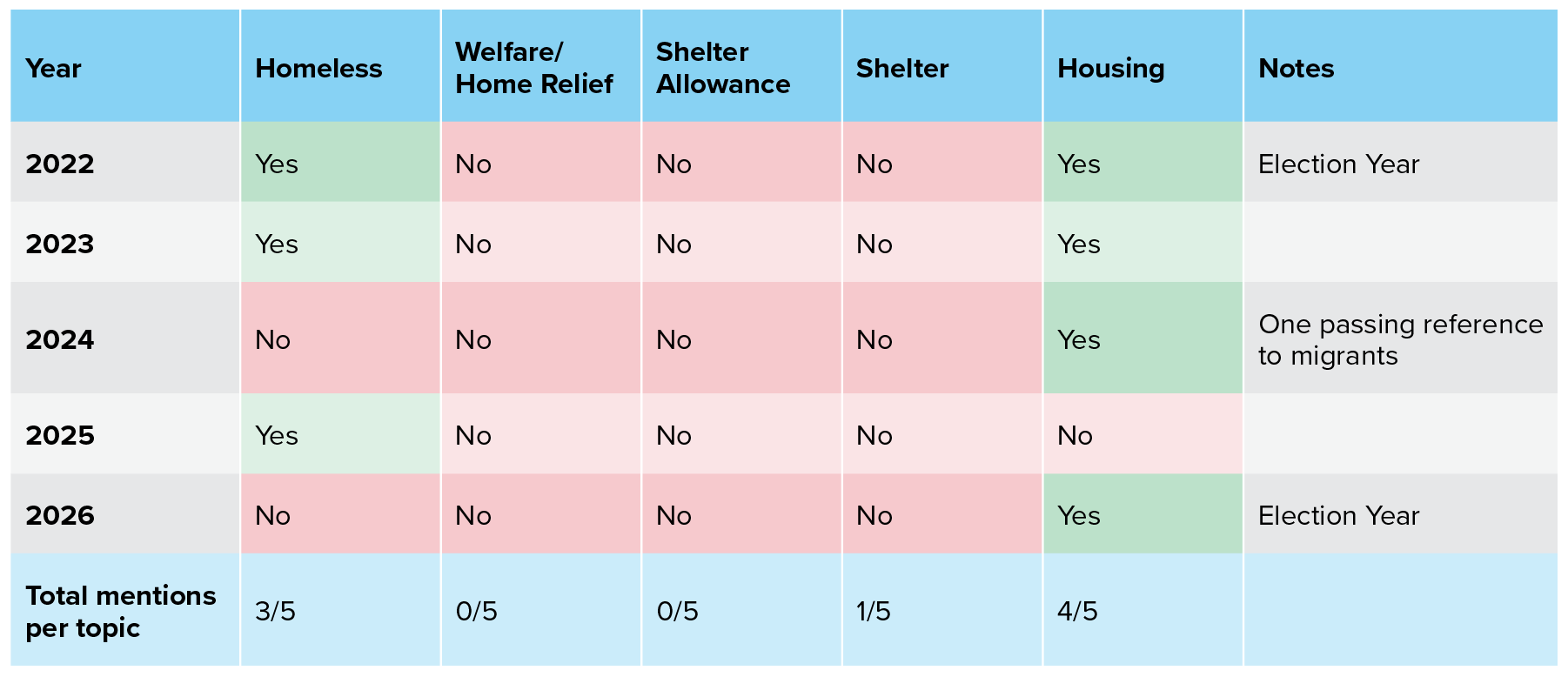
Hochul discussed the diversity of the homeless population in her first State of the State in 2022. “…We know that street homelessness only accounts for a small fraction of the homeless population. Beyond those sleeping on the streets, tens of thousands more people move in and out of shelters as they try to secure a place to call home and tragically many of them are children. We need to focus on addressing the root causes of homelessness: unmet mental health needs, poverty, addiction, and housing insecurity.”192 She then continued to introduce a plan to build over five years 100,000 units of affordable housing, including 10,000 units with supportive services.193 Hochul also proposed the Eviction Prevention Legal Assistance Program for upstate residents.194
The centerpiece of Hochul’s 2023 agenda was her New York Housing Compact, with a goal of building 800,000 units around the state within a decade.195 Every locality would have annual growth targets, and a combination of carrots and sticks were to be used to reach the goal. Unfortunately, the proposal was dead on arrival after meeting resistance from the suburban areas that were the focus of transit-oriented development and would have been required to rezone neighborhoods within a half mile of train stations.196 Hochul also unveiled a plan to build “3,500 residential units, supported by intensive mental health services.”197 Unlike the Housing Compact, the plan for supportive housing was included in the FY2024 budget.198
The 2024 State of the State acknowledged the failure of the Housing Compact but advocated for the New York City housing plan that would eventually come to be known as City of Yes.199 Hochul also announced efforts to build 15,000 new housing units on underutilized state-owned land.200
In her 2025 State of the State Hochul emphasized the need for involuntary commitment for individuals who could not care for themselves. “We cannot allow our subway to be a rolling homeless shelter.”201 She continued to push for more housing investments in both 2025 and 2026, unveiling her “Let Them Build” agenda to update state laws allowing “pro-housing” communities to build faster by easing regulations.202
Newcomers and the Right to Shelter
Early in her tenure (December 2021) Hochul signed Assembly Bill A8009, making the Family Homelessness and Eviction Prevention Supplement Program (FHEPS) vouchers equivalent to HUD’s fair market rent level.203 This event was concurrent with the New York City Council passing a bill to raise the CityFHEPS voucher value to the same Section 8 standard.204 By the end of 2021, both programs were on equal footing with Section 8.
Few could imagine, in the midst of that achievement and the general anticipation of what a new mayoral administration would bring in January 2022, that by the end of the year the shelter system would be on the verge of crisis.205 Family homelessness—its visible presence dispersed out of midtown’s welfare hotels in the 1990s206—returned to public view as families arrived at Manhattan’s Port Authority and headed east toward Grand Central to receive a shelter placement.
The FY2024 budget cycle presented the first opportunity to codify support for the city during the height of the asylum seeker crisis and maintain the spirit of the welcoming policy Rockefeller described in 1960. The Executive Budget proposed adhering to the Safety Net formula for both asylum seeker families and individuals, reimbursing the city 29 percent for shelter costs, up to $1 billion over two years.207 Funding ended up totaling $1.9 billion for FY2024. The FY2025 executive budget proposed a total $2.4 billion consisting of a base $1.9 billion matching the FY24 figure and $500 million in reserve funds to pay for one-time costs.208 The State ultimately committed to $3.25 billion in reimbursement for expenses covering FY 2023 through FY 2026.209
In parallel, Hochul was helping Mayor Eric Adams cope with the crisis by supporting his efforts to reopen the Right to Shelter case and temporarily suspend it for new arrivals.210 Adams filed an emergency request in May 2023 and was still awaiting a response from the court when in early October 2023 he took a different legal approach.211 Hochul wanted to ensure that the Right to Shelter would not apply statewide, something she became fearful of due to the case’s judge seemingly pushing the State to take a more proactive role in helping the City meet its obligations under the mandate.212
State-Issued Vouchers Piloted
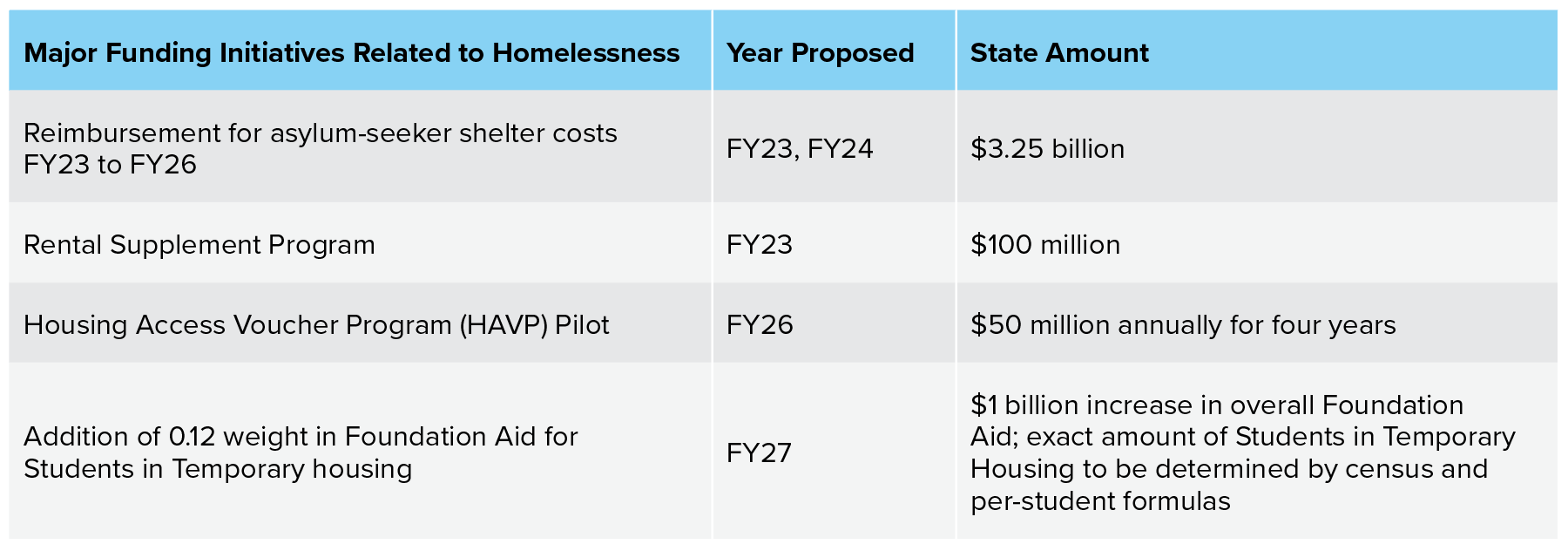
Legislators and advocates had been trying to get the Housing Access Voucher Program (HAVP) authorized since 2020.213 Akin to a state-level Section 8 voucher, the program would help New Yorkers both currently homeless and at imminent risk of homelessness.214 A four-year pilot made it into the FY26 budget, with $50 million allocated for the first year and the rest of the funding subsequent to future budget negotiations.215
While efforts to expand the program were not successful in FY27 budget negotiations and funding remained baselined at $50 million, advocates and lawmakers continue to call for full funding at the level of $250 million annually state-wide.216
Additional housing assistance funds became available in April 2022 when the State appropriated $100 million to the Rental Supplement Program (RSP). New York City would go on to launch its RSP-funded program, Special Housing Assistance Resource (SHARE), in May 2025, with funds targeted to long-term shelter stayers, many undocumented and ineligible for other available housing assistance.217
Another area where advocates long hoped to harmonize City and State efforts was with funding for students experiencing homelessness.
Starting in the 2023–2024 school year (FY24), the NYC DOE agreed on a weight of 0.12 for Students in Temporary Housing in the Fair Student Funding formula.218 In the FY27 state budget advocates successfully achieved the addition of an equivalent 0.12 weight for these students in the Foundation Aid formula to provide even more resources to these children and the schools that support them.219
Hochul’s administration did not issue any significant OTDA Administrative Directives around shelter or homelessness, other than biennial reminders to submit the Homeless Services Plan Cuomo initiated in the FY19 budget.220 Perhaps this stasis is indicative of a system that has calmed down—or the absence of micromanagement of the City’s operations. However, as of mid-2026 new regulations were brewing that would ensure that families residing in hotels outside of NYC have access to the same level of social services as that available in NYC-based shelters.221
Significant Developments in Homelessness Policy During Hochul’s Tenure
- FHEPS voucher raised to Fair Market Rent level
- Rental Supplement Program launched
- Asylum-seeker crisis
- Housing Access Voucher Program (HAVP) piloted
- Weight for Students in Temporary Housing added to Foundation Aid Formula
Conclusion

This brief history of the State’s role in the City’s provision of family shelter has focused on the key elements of (1) policy agenda-setting from the governor and/or legislature, (2) budgetary decisions made by the legislature and governor, and (3) administrative regulations issued.
A governor’s commitment to pursuing a certain policy agenda sets the direction and shapes change while disinterest in an issue or distraction due to other pressing matters can stall action or allow the City to pursue its own path on the issue until it hits a roadblock. Budgetary decisions follow from these policy prerogatives, though sometimes in lean times governors have to make hard choices and shift funding priorities, despite a stated commitment to an issue. Administrative regulations can support democratically decided legislative and budgetary policies or they can materialize as attempts to micromanage or dictate without stakeholder input—such actions appear to have been more prevalent prior to the 2008 McCain v. Koch settlement or in times of City and State disagreement.
As New York State and New York City continue to grapple with the family homelessness crisis, the framework provided by these three elements can be helpful in tracking each entity’s response to new developments, helping observers, providers, advocates, and families in the midst of crisis understand where the levers of power are on a given action and who they need to persuade if they have a difference in opinion.
Thomas Main observed that the path to an operational right to shelter in New York City resulted from “a fragmented political environment.” While usually viewed as creating many “veto points,” such a public arena can also create “opportunity points.” Main viewed incremental input from the courts and state in particular as crucial to the present outcome of “effectively a right to shelter for families.”222
And as such, after the McCain v. Koch settlement, it may have seemed as though questions around eligibility for family shelter were, perhaps…settled. However, there were skirmishes in the ensuing decade and a half that came to a head when the asylum seeker shelter census crisis emerged in 2022. All of a sudden, the Right to Shelter was once again an open question that some leaders believed needed a more permanent resolution. Some advocates and elected officials like former NYC Comptroller Brad Lander suggested a mechanism for expanding the right to shelter outside of New York City, “Rather than seeking permission to gut the right to shelter, the City should ask the Court instead to clarify that this right, grounded in the New York State Constitution, applies to all municipalities and counties across the state.”223
Governor Hochul took a different tack than did Lander. She said, “We brought in outside constitutional experts to assist with managing this because we believe, and I’m convinced, that the right to shelter is the result of a consent decree undertaken by the city of New York and Legal Aid Society back in 1979. The state is not a party to that, so the right to shelter does not expand to the whole of the state.”224 Coalition for the Homeless stated, “Even though New York State is a party in the original Callahan litigation, no agreement was reached with the State as part of [the March 15, 2024] settlement.”225 The terms of the March 2024 settlement between the City of New York and Legal Aid were that for a temporary “Crisis Plan Period”; Single Adult New Arrivals would be eligible for shelter for only 30 (if age 23+) or 60 days (if under age 23).226
Although the federal investment in homelessness has grown considerably over the period covered in this report, the majority of money spent on homelessness nationwide comes out of state and local coffers.227 The FY26 federal budget approved $4.4 billion in homeless assistance grants nationwide. Yet New York City’s modified FY26 budget for DHS alone was nearly $4.5 billion ($3.7+ billion City funds), and the adopted budget for FY27 over $4.2 billion (nearly $3.5 billion City funds). The asymmetry in fund allocation stands out.
During a Congressional hearing in 1986, James C. Miller, Ronald Reagan’s director of the Office of Management and Budget, agreed during questioning that homelessness was a problem in the United States. “‘It is a very bad thing; it tugs on one’s heart strings.’” But there was a caveat. “‘We believe the homeless are not a Federal responsibility but a state and local responsibility.’”228
Advocates for homeless families in New York City take a different view: “We need every level of government—city, state, and federal—to step up and prioritize family homelessness prevention.”229
While it may seem insurmountable to move Congress to designate more money for the crisis, efforts to increase state spending are a major focus at present. Advocates and legislators continue to call for an increase to the shelter (housing) allowance so that it, just like the CityFHEPS and FHEPs vouchers, adheres to HUD fair market rent values.230 A related NYS Senate bill and NYS Assembly bill have both been referred to the Social Services committee of their respective bodies.231 Among the Child Poverty Reduction Advisory Council’s (CPRAC) recommendations have been providing families with housing assistance at Fair Market Rent levels. Whether the governor and legislature believe this is best accomplished through raising the shelter allowance or expanding access to vouchers through HAVP or FHEPS remains to be seen but will likely continue to be a pressing issue until resolved.
In one effort at resolution, in June 2026 The Legal Aid Society and Empire Justice Center filed a lawsuit in New York Supreme Court (Ivy, Willie et al vs. New York State Office of Temporary and Disability Assistance, et al) seeking either an increase in the shelter allowance for families and individuals or an expansion to all household types of the rental supplement currently only offered to families with minor children.232 The supplement pays for the difference between the shelter (housing) allowance and the rent amount. As discussed earlier in this report, the shelter (housing) allowance for families has not been increased in over 20 years—despite a requirement to review it every five years—and all efforts to make that change have fallen short. With affordability the key driver of this political moment locally, at the state level, and nationally will this effort finally be the one that breaks through? The lawsuit will wind its way through court as the people of New York select a governor, and by extension, the personnel that will oversee the state’s role in the provision of aid, care, and support to families experiencing homelessness. Will the courts weigh in as they so often have in changing the direction of how New York City and New York State address the crisis? Will the person who holds the governor’s seat in January 2027 pursue a policy agenda and craft a budget that finally addresses these gaps? Only time will tell.
Based on the history highlighted in this report, New York State has at times believed that caring for individuals and families experiencing homelessness is a joint City–State responsibility and at other times—particularly fiscally lean times—best left to the locality. What is clear is that as a creature of the state,233 NYC will never be fully able to go it alone in this mission, and it shouldn’t have to. In many ways the parallel programs of the last decade, such as FHEPS and CityFHEPS, which have the same goals and adequate benefit levels, seem to show a way forward. The City and State should continue to develop policy agendas and equitably fund programs that will first stabilize families and then empower them to thrive.
The New York State Comptroller’s July 2026 report, “Homelessness Falls Statewide, But Rises in Many New York Regions” concludes with this charge, “Policies that can mitigate evictions and provide housing assistance, particularly to families with children, should continue to remain a focus of policymakers at federal, state and local levels.” The sincerest hope of the ecosystem that supports New York’s homeless families is that the governor and mayor will enter the next budget cycle with the goal of forging a unified policy path and writing a new history on how they tackled family homelessness together.
Endnotes
- New York City in the Great Depression: Sheltering the Homeless. Miller, Dorothy Laager. New York: Arcadia Publishing, 2009. https://books.google.com/books?id=WoItjdbA4tEC&pg=PA11&lpg=PA11&dq=Municipal+Lodging+House++was+demolished&source=bl&ots=sKpODmtIHi&sig=ACfU3U3xU2OeLoulEZnFdWIUagoiqy0hwQ&hl=en&sa=X&ved=2ahUKEwiNi9f7l8XpAhVMl3IEHfzzB3QQ6AEwD3oECAkQAQ#v=onepage&q=Municipal%20Lodging%20House%20%20was%20demolished&f=false; https://flatironnomad.nyc/history/municipal-lodging-house/; https://www.nytimes.com/1991/12/22/realestate/streetscapes-the-municipal-lodging-house-a-1909-home-for-the-homeless.html
- https://www.nytimes.com/1991/12/22/realestate/streetscapes-the-municipal-lodging-house-a-1909-home-for-the-homeless.html
- Laws of the State of New York passed at the session of the Legislature 1886, Chap.535. AN ACT to provide for the establishment of municipal lodging-houses in the city of New York. https://babel.hathitrust.org/cgi/pt?id=iau.31858017076740&seq=778
- https://www.icph.org/wp-content/uploads/2022/03/ICPH_Mayors-Report_WEB_030822.pdf
- https://spectrumlocalnews.com/nys/central-ny/politics/2026/07/23/comptroller-report–homelessness-up-in-parts-of-upstate-n-y-; https://www.osc.ny.gov/reports/homelessness-falls-statewide-rises-many-new-york-regions.
- https://www.ibo.nyc.gov/content/publications/2015-october-albany-shifts-the-burden-as-the-cost-for-sheltering-the-homeless-rises; https://web.archive.org/web/20221127124958/https://ibo.nyc.ny.us/iboreports/governor-questions-citys-homeless-efforts-despite-nycs-expanded-outreach-and-prevention-programs-march-2018.pdf; https://web.archive.org/web/20230921175849/https://ibo.nyc.ny.us/iboreports/governors-budget-would-add-to-citys-rising-share-of-homeless-sheltercosts-fopb-march-2019.pdf; https://www.ibo.nyc.gov/content/publications/2023-march-how-have-city-costs-changed-with-shifts-in-state-and-federal-support-for-homeless-shelters; https://www.nyc.gov/assets/dhs/downloads/pdf/dhs-dss-fiscal-manual-2022.pdf
- https://www.ibo.nyc.gov/content/publications/2015-october-albany-shifts-the-burden-as-the-cost-for-sheltering-the-homeless-rises
- https://www.ibo.nyc.gov/content/publications/2015-october-albany-shifts-the-burden-as-the-cost-for-sheltering-the-homeless-rises
- https://www.ibo.nyc.gov/content/publications/2015-october-albany-shifts-the-burden-as-the-cost-for-sheltering-the-homeless-rises
- https://www.ibo.nyc.gov/content/publications/2015-october-albany-shifts-the-burden-as-the-cost-for-sheltering-the-homeless-rises
- https://www.nyc.gov/assets/omb/downloads/pdf/adopt25/erc6-25.pdf
- https://www.nytimes.com/2006/12/28/nyregion/28veto.html; https://www.nga.org/governor/hugh-leo-carey/
- https://www.nytimes.com/1984/01/23/nyregion/carey-years-in-albany-top-aide-looks-back.html
- https://legalaidnyc.org/court-case/callahan-v-carey/; https://www.coalitionforthehomeless.org/our-programs/advocacy/legal-victories/the-callahan-legacy-callahan-v-carey-and-the-legal-right-to-shelter/; https://www.coalitionforthehomeless.org/wp-content/uploads/2014/08/CallahanNYTarticleonfirstcourtdecision12-9-1979.pdf
- The Poor Among Us, p. 203
- Hayes and other advocates officially formed the Coalition for the Homeless in 1980 in the midst of the drama between Carey and Koch over the increasing number of homeless people in the streets in New York City. See https://www.coalitionforthehomeless.org/our-history/ for details
- Main, p. 86; Kim Hopper and L. Stuart Cox. “Litigation in Advocacy for the Homeless: The Case of New York City” (New York: Coalition for the Homeless, May 1982).
- Main, p. 86
- https://www.nysenate.gov/legislation/laws/CNS/A17S1
- Main p. 88
- Main, p. 351–353
- https://www.nytimes.com/1964/12/29/archives/relief-need-put-at-half-a-billion-81-million-budget-rise-is-asked.html
- https://www.congress.gov/91/crecb/1970/12/22/GPO-CRECB-1970-pt32-4-2.pdf, p. 43440; https://www.govinfo.gov/content/pkg/GPO-CRECB-1970-pt33/pdf/GPO-CRECB-1970-pt33-3-2.pdf, p. 44159; https://www.congress.gov/92/crecb/1971/03/31/GPO-CRECB-1971-pt7-3-2.pdf p. 8942; https://www.nytimes.com/1971/01/17/archives/walsh-urges-social-services-in-public-housing.html; https://www.congress.gov/92/crecb/1971/10/04/GPO-CRECB-1971-pt26-5-2.pdf, p. 34844
- https://www.nytimes.com/1970/12/13/archives/koch-assails-city-on-welfare-hotels.html
- https://www.nytimes.com/1982/03/05/nyregion/city-temporarily-sheltering-over-700-homeless-families.html
- https://www.nytimes.com/1988/12/27/nyregion/as-a-hotel-is-emptied-the-poor-move-on.html
- Main, p. 120, 189
- Main, 109.
- Main, p. 110, 140
- https://www.nytimes.com/1981/12/01/nyregion/city-plans-to-expand-use-of-armories-to-house-homeless-men.html
- https://www.coalitionforthehomeless.org/wp-content/uploads/2014/06/CallahanConsentDecree.pdf
- https://www.coalitionforthehomeless.org/wp-content/uploads/2014/06/CallahanConsentDecree.pdf
- Main, 118–119; https://ir.lawnet.fordham.edu/ulj/vol24/iss1/4/; https://www.law.cornell.edu/wex/stay
- https://legalaidnyc.org/wp-content/uploads/2025/09/Vincent-v.-Adams-Opp-to-Motion-for-Leave-and-5519c-cross-motion-MOL-Aff-Exh-A.pdf; https://www.cityandstateny.com/policy/2023/08/could-new-york-citys-right-shelter-apply-statewide/389450/; https://www.nycourts.gov/courts/ad1/calendar/AppsMots/2025/mots/20251007/M-4390%20&%20M-4698.pdf; https://citylimits.org/adams-administration-delays-cityfheps-expansion-again-asks-court-for-appeal/; https://www.thecity.nyc/2025/11/10/city-fheps-vouchers-rent-city-council-adams/; https://citylimits.org/honor-his-promise-advocates-criticize-mamdanis-cityfheps-reversal-and-what-else-happened-this-week-in-housing/
- https://legalaidnyc.org/news/300m-settlement-expand-housing-voucher-access/
- https://www.nytimes.com/1982/01/12/opinion/l-to-new-york-state-no-one-is-expendable-168710.html
- https://www.nytimes.com/1982/07/09/nyregion/summary-of-major-actions-taken-by-new-york-legislature-in-1982-session.html
- https://www.nytimes.com/1982/01/12/opinion/l-to-new-york-state-no-one-is-expendable-168710.html
- https://www.nytimes.com/1980/12/29/archives/carey-says-city-worsens-plight-of-the-homeless-defends-state-on.html
- https://www.nytimes.com/1982/07/09/nyregion/summary-of-major-actions-taken-by-new-york-legislature-in-1982-session.html; https://www.nytimes.com/1982/01/12/opinion/l-to-new-york-state-no-one-is-expendable-168710.html
- https://www.nytimes.com/1983/05/15/nyregion/17-groups-await-aid-for-homeless.html
- Main, p. 124
- https://www.nytimes.com/1982/05/21/nyregion/suit-on-homeless-mental-patients-asks-new-york-state-for-housing.html
- https://www.nytimes.com/1982/10/05/nyregion/lawsuit-that-sought-homes-for-homeless-dismissed-by-a-judge.html
- https://www.nytimes.com/1982/10/05/nyregion/lawsuit-that-sought-homes-for-homeless-dismissed-by-a-judge.html
- https://www.nytimes.com/1984/03/28/nyregion/ex-mental-patients-upheld-on-suing.html
- https://www.coalitionforthehomeless.org/our-programs/advocacy/legal-victories/other-coalition-for-the-homeless-legal-victories/; https://mhp.urbanjustice.org/2019/09/09/koskinas-v-cuomo/
- Report and Recommendations of the New York State Bar Association Task Force on Homelessness and the Law. January 2025. https://nysba.org/wp-content/uploads/2023/02/2025-January-Report-and-Recommendations-of-the-Task-Force-on-Homelessness-and-the-Law-FINAL-with-HOD-Amendment-1.21.25.pdf?srsltid=AfmBOookVduTqDymtm4B-puE-uoTny4LxCa2zNO-HA-4zk8K9RL9SdEQ
- https://empirejustice.org/wp-content/uploads/2023/08/REPORT-No-Keys-to-Safe-and-Decent-Housing-in-NYs-Safety-Net-8.23.23.pdf; https://www.nytimes.com/1968/07/17/archives/flat-grants-in-welfare.html; https://www.nytimes.com/1969/05/05/archives/summary-of-actions-taken-in-albany-by-legislature-during-regular.html; https://www.nytimes.com/1969/07/04/archives/welfare-job-referral-mandate-expected-to-affect-15000-here.html
- https://empirejustice.org/wp-content/uploads/2023/08/REPORT-No-Keys-to-Safe-and-Decent-Housing-in-NYs-Safety-Net-8.23.23.pdf;
- https://www.finance.senate.gov/imo/media/doc/hrg103-1011.pdf; https://shnny.org/supportive-housing/what-is-supportive-housing/history-of-supportive-housing/; https://www.coalitionforthehomeless.org/why-are-so-many-people-homeless/
- https://shnny.org/supportive-housing/what-is-supportive-housing/history-of-supportive-housing/
- Main, 232-233; https://www.nyc.gov/site/finance/property/property-in-rem-forclosure.page
- Main, 233
- https://openbudget.ny.gov/historicalFP/classic/MidYear8384.pdf
- https://openbudget.ny.gov/historicalFP/classic/MidYear8384.pdf
- https://openbudget.ny.gov/historicalFP/classic/MidYear8384.pdf
- https://www.nytimes.com/1985/12/20/nyregion/cuomo-backs-proposal-to-house-2000-families.htmls
- https://otda.ny.gov/programs/housing/hhap.asp; https://otda.ny.gov/programs/housing/documents/HHAC/HHAC-Enabling-Statute.pdf; https://digitalcommons.nyls.edu/cgi/viewcontent.cgi?article=1052&context=journal_of_human_rights
- https://otda.ny.gov/programs/housing/documents/HHAC/HHAC-Enabling-Statute.pdf
- https://www.nytimes.com/1985/01/24/nyregion/cuomo-seeks-a-45-rise-in-aid-to-homeless.html
- See chart
- See chart
- https://www.nytimes.com/1986/01/09/nyregion/text-of-cuomo-s-4th-state-of-state-address-to-the-legislature.html
- https://www.nytimes.com/1988/01/07/nyregion/excerpts-from-cuomo-address-preparing-for-the-21st-century.html; https://www.nytimes.com/1988/01/07/nyregion/cuomo-issues-call-to-help-children.html
- https://nysl.ptfs.com/aw-server/rest/product/purl/NYSL/s/292ee3ef-92a2-4fba-bfa5-ae621ad25edf
- https://www.governormariocuomo.com/1990-ny-state-of-the-state-address
- Main, p. 193-194
- https://www.nytimes.com/1991/09/18/nyregion/new-york-admits-failure-of-homeless-family-effort.html, Main 261
- Main, p. 231. It exceeded these goals with 7,774 people having resided in these units by December 31, 2000 (Main, 242).
- https://shnny.org/blog/entry/mario-cuomos-legacy/
- https://shnny.org/blog/entry/mario-cuomos-legacy/; https://shnny.org/supportive-housing/faq/
- Main, 150, 152
- Main, p. 156
- Main, p. 156-157
- https://www.nytimes.com/1983/08/24/nyregion/city-aides-inspect-welfare-hotels.html
- https://www.nytimes.com/1983/08/23/nyregion/medical-exams-set-for-7000-children-on-koch-s-orders.html
- https://www.nytimes.com/1983/09/04/nyregion/cuomo-seeks-rent-aid-increase-for-welfare-families.html; https://openbudget.ny.gov/historicalFP/classic/MidYear8485.pdf
- https://www.nytimes.com/1984/01/05/nyregion/transcript-of-cuomo-s-address-to-the-new-york-legislature.html; https://www.nytimes.com/1984/01/09/opinion/l-what-new-york-city-welfare-families-get-161543.html
- https://www.nytimes.com/1983/09/04/nyregion/cuomo-seeks-rent-aid-increase-for-welfare-families.html
- https://ocfs.ny.gov/main/policies/external/1992/LCMs/92-LCM-149%20Enclosed%20are%20materials%20distributed%20by%20Income%20Maintenance%20at%20the%20September%20meeting%20-%20NYPWA%20Committee%20Meetings;%20Distribution%20of%20Materials.pdf; https://www.nytimes.com/1984/01/09/opinion/l-what-new-york-city-welfare-families-get-161543.html; https://www.nytimes.com/1988/01/13/nyregion/judge-orders-readjustment-of-allowances-for-housing.html
- Main, p. 158
- Main, 165
- https://www.nytimes.com/1985/08/28/nyregion/city-barred-from-sheltering-homeless-families-in-offices.html
- Main, p. 168
- Main, p. 429
- “Homeless Legislation Eyed.” The Journal Ogdensburg, NY Vol 26 No 8481, 5 March 1986. Accessed at https://www.nyshistoricnewspapers.org/?a=d&d=jou19860305-01.1.2&e=——-en-20–1–txt-txIN———-; https://otda.ny.gov/policy/directives/1992/ADM/92_ADM-46.pdf; https://legalaidnyc.org/wp-content/uploads/2025/12/McCain-appellate-brief.pdf
- Main, p. 181
- Main, p. 187
- https://www.nytimes.com/1987/10/05/nyregion/shift-seen-on-welfare-hotel-use.html; https://www.nytimes.com/1987/12/13/nyregion/new-york-to-fight-cuts-in-aid-to-homeless.html; https://scholarship.law.nd.edu/cgi/viewcontent.cgi?article=1295&context=jleg
- https://www.nytimes.com/1987/10/05/nyregion/shift-seen-on-welfare-hotel-use.html
- https://www.nytimes.com/1988/08/02/nyregion/hotel-shelters-to-end-by-90-koch-says.html
- https://www.nytimes.com/1988/07/15/nyregion/koch-plan-would-speed-welfare-hotels-closing.html; https://www.nytimes.com/1988/08/02/nyregion/hotel-shelters-to-end-by-90-koch-says.html
- Main, p. 253; https://www.nytimes.com/1990/08/22/nyregion/new-york-violates-welfare-ban.html
- Main, 363
- Main, p. 408
- https://web.archive.org/web/20251207195410/; https://www.ibo.nyc.ny.us/iboreports/pubwelf.html
- https://www.nytimes.com/1997/05/20/nyregion/local-officials-break-ranks-over-pataki-s-welfare-plan.html
- https://www.nytimes.com/1997/05/20/nyregion/local-officials-break-ranks-over-pataki-s-welfare-plan.html
- See compiled charts.
- Main, p. 460-461
- https://www.nytimes.com/2004/12/11/nyregion/state-revamps-assistance-plan-for- homeless.html
- https://www.nytimes.com/2004/12/11/nyregion/state-revamps-assistance-plan-for-homeless.html
- Main, p. 15, p. 519-521
- Main, p. 365
- Main, p. 410
- Main, p. 423; https://govt.westlaw.com/nycrr/Document/I50c3e46fcd1711dda432a117e6e0f345?viewType=FullText&originationContext=documenttoc&transitionType=CategoryPageItem&contextData=(sc.Default)
- Main, p. 425
- https://empirejustice.org/wp-content/uploads/2023/04/COMMENT-Shelter-Allowance-Rule-Review-of-18-NYCRR-Part-352.pdf; https://empirejustice.org/wp-content/uploads/REPORT-No-Keys-to-Safe-and-Decent-Housing-in-NYs-Safety-Net-8.23.23.pdf
- https://otda.ny.gov/policy/directives/2003/ADM/03_ADM-07.pdf
- https://otda.ny.gov/policy/directives/2003/ADM/03_ADM-07.pdf
- https://legalaidnyc.org/court-case/jiggetts-v-grinker/
- https://www.gothamgazette.com/housing/1766-governors-proposed-budget-bad-news-for-low-income-new-yorkers/; https://citylimits.org/no-more-jiggetts-state-launches-rent-subsidy/
- Main, 503–504
- https://nypost.com/2002/12/03/homeless-judge-up-for-promotion/
- https://www.nytimes.com/2003/11/05/nyregion/pataki-puts-nonjudge-on-court-of-appeals.html
- https://www.icph.org/wp-content/uploads/2022/03/ICPH_Mayors-Report_WEB_030822.pdf
- https://www.nytimes.com/2014/11/03/nyregion/bernard-spitzer-new-york-developer-and-philanthropist-dies-at-90.html
- https://www.recordonline.com/story/news/2007/01/04/spitzer-s-state-state-one/52969511007/
- https://www.oneidadispatch.com/2008/01/09/gov-eliot-spitzers-state-of-the-state-address-full-text-version/
- https://www.oneidadispatch.com/2008/01/09/gov-eliot-spitzers-state-of-the-state-address-full-text-version/
- https://www.nga.org/governor/eliot-spitzer/; https://www.nytimes.com/2007/04/02/nyregion/02health.html
- https://www.nytimes.com/2007/04/02/nyregion/02health.html
- https://www.nytimes.com/2008/03/13/nyregion/13legal.html; https://www.nytimes.com/2008/03/12/nyregion/12cnd-resign.html
- https://www.nga.org/governor/david-a-paterson/
- https://citylimits.org/spitzers-housing-fund-advances-with-paterson/
- https://www.dfs.ny.gov/insurance/ogco2003/rg030809.htm
- https://www.osc.ny.gov/files/reports/budget/pdf/budget-enacted-preliminary-2008-09.pdf; https://www.nysenate.gov/newsroom/press-releases/2008/liz-krueger/krueger-praises-investment-affordable-housing-new-york
- https://citylimits.org/a-settlement-thats-final-permanent-enforceable/
- Main, p. 555; https://nypost.com/2008/07/28/judge-freedman-moves-on/
- https://www.nytimes.com/2008/09/18/nyregion/18homeless.html
- Main, p. 555
- https://citylimits.org/a-settlement-thats-final-permanent-enforceable/
- https://citylimits.org/a-settlement-thats-final-permanent-enforceable/
- https://archive.nytimes.com/cityroom.blogs.nytimes.com/2008/09/17/city-settles-lawsuit-over-homeless-families/; https://www.nytimes.com/2008/09/18/nyregion/18homeless.html
- https://archive.nytimes.com/cityroom.blogs.nytimes.com/2009/03/05/bloomberg-slams-paterson-over-stimulus-money/
- 2009: 24; 2010: 7; 2011: 8.
- https://www.coalitionforthehomeless.org/wp-content/uploads/2014/06/BriefingPaper-ProtectingHomelessNewYorkersfromShelterRentandSanctions-Updated-8-10-2009.pdf; https://www.nytimes.com/2009/05/22/nyregion/22homeless.html
- https://www.coalitionforthehomeless.org/victory-agreement-reached-to-end-misguided-shelter-rent-rules/
- https://www.nytimes.com/2008/12/23/nyregion/23homeless.html
- https://www.nytimes.com/2008/12/23/nyregion/23homeless.html; https://www.huffpost.com/entry/patersons-record-cut-duri_b_492240; https://www.ibo.nyc.gov/content/publications/2015-october-albany-shifts-the-burden-as-the-cost-for-sheltering-the-homeless-rises
- https://citylimits.org/budget-could-hit-local-homeless-program-hard/
- https://www.budget.ny.gov/pubs/archive/fy1011archive/enacted1011/2010-11FinancialPlanReport.pdf
- https://www.nytimes.com/2010/02/27/nyregion/27paterson.html
- The Institute of Children, Poverty, and Homelessness (2013). History of Poverty & Homelessness in NYC, http://povertyhistory.org/. Site no longer active but last archived snapshot available at https://web.archive.org/web/20221206012629/http://povertyhistory.org/
- ICPH, Homeless Families in NYC: The Public Policies of Four Mayors; ICPH, History of Poverty & Homelessness in NYC.
- https://web.archive.org/web/20240305130610/https://files.hudexchange.info/resources/documents/CoC101.pdf
- https://web.archive.org/web/20240305130610/https://files.hudexchange.info/resources/documents/CoC101.pdf
- https://archives.hud.gov/reports/2020/mrindex.cfm; https://archives.hud.gov/secretaries/cuomobio.cfm; https://archives.hud.gov/news/1997/pr97-109.cfm
- See spreadsheet
- https://www.nytimes.com/2015/01/19/nyregion/cuomo-to-propose-raising-minimum-wage-to-11-50-in-new-york-city-and-10-50-elsewhere.html
- New York City Independent Budget Office, Albany Shifts the Burden: As the Cost for Sheltering the Homeless Rises, Federal & City Funds Are Increasingly Tapped, October 2015, https://www.ibo.nyc.gov/content/publications/2015-october-albany-shifts-the-burden-as-the-cost-for-sheltering-the-homeless-rises New York City Independent Budget Office, Governor’s Budget Would Add to City’s Rising Share of Homeless Shelter Costs, March 2019, https://web.archive.org/web/20230921175849/; https://ibo.nyc.ny.us/iboreports/governors-budget-would-add-to-citys-rising-share-of-homeless-sheltercosts-fopb-march-2019.pdf; https://www.nytimes.com/2016/01/13/nyregion/as-cuomo-acts-on-homelessness-problem-city-and-state-are-often-at-odds.html
- https://www.nytimes.com/2016/01/13/nyregion/as-cuomo-acts-on-homelessness-problem-city-and-state-are-often-at-odds.html
- https://www.nytimes.com/2016/01/13/nyregion/as-cuomo-acts-on-homelessness-problem-city-and-state-are-often-at-odds.html; According to Main, p. 589-590 there was some dispute over the actual figures, with the state claiming lower costs and the city higher ones.
- ICPH, History of Poverty & Homelessness in NYC.
- https://www.coalitionforthehomeless.org/taking-advantage-of-homeless-families/
- https://citylimits.org/critics-of-homeless-program-fight-to-save-it/
- https://www.nytimes.com/2016/01/13/nyregion/as-cuomo-acts-on-homelessness-problem-city-and-state-are-often-at-odds.html; https://www.coalitionforthehomeless.org/new-report-half-of-advantage-families-back-in-the-nyc-shelter-system/; https://www.thecity.nyc/2020/02/25/how-mike-bloomberg-s-nyc-homeless-record-clashes-with-campaign-promises/
- https://fordschool.umich.edu/news/2023/former-nyc-mayor-bill-de-blasio-joins-ford-school-towsley-foundation-policymaker
- https://www.nyc.gov/assets/dhs/downloads/pdf/testimony/linc_testimony_1.21.15.pdf
- https://www.nyc.gov/assets/dhs/downloads/pdf/testimony/linc_testimony_1.21.15.pdf
- https://citylimits.org/opinion-every-level-of-government-must-step-up-efforts-to-address-family-homelessness/; https://www.nyc.gov/assets/hra/downloads/pdf/news/internet_articles/2014/oct_2014/LINC_RentalAssistProg_PublicHearing.pdf
- https://www.vocal-ny.org/wp-content/uploads/2022/02/Rising-Homeless-in-New-York-State-2016-2.pdf
- https://citylimits.org/no-more-jiggetts-state-launches-rent-subsidy/, https://www.coalitionforthehomeless.org/recovering-from-lost-decade-rent-supplements-reducing-homelessness/, https://web.archive.org/web/20240526085841/http://onlineresources.wnylc.net/nychra/docs/new_pd_17-26-eli.pdf
- https://www.icph.org/wp-content/uploads/2022/03/ICPH_Mayors-Report_WEB_030822.pdf; https://cbcny.org/research/cityfheps-hits-1-billion
- https://winnyc.org/wp-content/uploads/2026/02/More-Than-a-Moral-Choice-How-CityFHEPS-Could-Save-NYC-635-Million-2.pdf#:~:text=Although%20TANF%20dollars%20currently%20make%20up%20less,if%20the%20City%20decided%20to%20do%20so.
- Main, p. 31–32
- https://otda.ny.gov/hearings/transmittals/2015/15-02.pdf
- https://otda.ny.gov/policy/directives/2015/ADM/15-ADM-06-T.pdf
- Main, p. 31–32
- https://legalaidnyc.org/wp-content/uploads/2024/01/Letter-to-Governor-Hochul-Regarding-Crucial-Need-for-Increases-in-Cash-Assistance.pdf; https://www.vocal-ny.org/wp-content/uploads/2022/02/Rising-Homeless-in-New-York-State-2016-2.pdf
- 2015 (9); 2016 (11); 2017 (11); 2018 (9); 2019 (3)
- https://www.nytimes.com/2016/01/14/nyregion/for-de-blasio-cuomos-state-of-the-state-address-holds-more-tough-news.html
- https://www.nytimes.com/2016/01/13/nyregion/as-cuomo-acts-on-homelessness-problem-city-and-state-are-often-at-odds.html
- https://assembly.state.ny.us/mem/Andrew-Hevesi/story/66624
- https://assembly.state.ny.us/mem/Andrew-Hevesi/story/66624
- https://www.nytimes.com/2016/01/14/nyregion/cuomo-state-of-state-speech-new-york-homelessness-ethics.html; https://hcr.ny.gov/governor-cuomo-launches-landmark-20-billion-plan-combat-homelessness-and-create-affordable-housing
- Main, p. 18-19, p. 24; https://www.politico.com/states/new-york/albany/story/2016/02/homeless-housing-gets-boost-from-cuomo-de-blasio-feud-030749
- https://hcr.ny.gov/governor-cuomo-announces-major-milestone-creating-and-preserving-over-62000-units-affordable-and
- https://citylimits.org/cuomos-housing-budget-must-go-farther-some-advocates-say/
- https://web.archive.org/web/20221127124958/https://ibo.nyc.ny.us/iboreports/governor-questions-citys-homeless-efforts-despite-nycs-expanded-outreach-and-prevention-programs-march-2018.pdf; https://www.budget.ny.gov/pubs/press/2018/pr-enactfy19.html
- Governor’s Press Office, Governor Cuomo Signs the COVID-19 Emergency Eviction and Foreclosure Prevention Act of 2020, December 28, 2020, https://www.governor.ny.gov/news/governor-cuomo-signs-covid-19-emergency-eviction-and-foreclosure-prevention-act-2020
- https://comptroller.nyc.gov/services/for-the-public/charting-homelessness-in-nyc/overview/
- https://citylimits.org/opinion-every-level-of-government-must-step-up-efforts-to-address-family-homelessness/; https://www.nysenate.gov/legislation/bills/2021/A8009; https://www.governor.ny.gov/news/governor-hochul-signs-legislation-combat-homelessness-and-expand-housing-affordability-new
- https://www.kut.org/politics/2022-08-05/gov-greg-abbott-says-texas-is-now-busing-migrants-to-new-york-city
- https://www.nytimes.com/1971/03/29/archives/welfare-residency-law-vetoed-by-rockefeller-in-1960-advocated-by.html
- https://www.nysenate.gov/legislation/bills/2021/S2755
- https://www.governor.ny.gov/news/governor-hochul-launches-first-ever-advisory-council-reduce-child-poverty-statewide
- https://otda.ny.gov/cprac/reports/CPRAC-2024-Recommendations-and-Progress-Report.pdf
- https://otda.ny.gov/cprac/reports/CPRAC-2025-Progress-Report.pdf
- https://otda.ny.gov/cprac/reports/CPRAC-Progress-Report-2023.pdf
- https://www.btpm.org/2022-01-05/hear-governor-hochuls-state-of-the-state-address
- https://www.btpm.org/2022-01-05/hear-governor-hochuls-state-of-the-state-address
- https://www.nytimes.com/2022/01/05/nyregion/kathy-hochul-state-of-ny-speech.html; https://hcr.ny.gov/news/governor-hochul-announces-launch-comprehensive-25-billion-housing-plan-historic-fy-2023-budget; https://otda.ny.gov/programs/emergency-rental-assistance/legal-providers/
- https://www.governor.ny.gov/news/remarks-prepared-governor-hochul-delivers-2023-state-state
- https://www.nytimes.com/article/nyc-housing-hochul-long-island-westchester.html; https://www.governor.ny.gov/news/remarks-prepared-governor-hochul-delivers-2023-state-state
- https://www.governor.ny.gov/news/remarks-prepared-governor-hochul-delivers-2023-state-state
- https://shnny.org/blog/entry/2023-24-state-budget-passes
- Once it passed Hochul pledged, subject to budget approval, to commit $1 billion in housing capital over five years. https://www.nyc.gov/mayors-office/news/2024/11/mayor-adams-governor-hochul-celebrate-agreement-advance-historic-plan-build-affordable
- https://www.governor.ny.gov/news/video-audio-photos-remarks-prepared-governor-hochul-delivers-2024-state-state-address
- https://www.governor.ny.gov/news/remarks-prepared-governor-hochul-delivers-2025-state-state-address
- https://www.governor.ny.gov/programs/let-them-build
- https://citylimits.org/opinion-every-level-of-government-must-step-up-efforts-to-address-family-homelessness/; https://www.nysenate.gov/legislation/bills/2021/A8009; https://www.governor.ny.gov/news/governor-hochul-signs-legislation-combat-homelessness-and-expand-housing-affordability-new; https://legalaidnyc.org/wp-content/uploads/2021/12/FHEPS-final-budget-numbers.pdf
- https://citylimits.org/de-blasio-agrees-to-fast-track-rental-voucher-increase-for-homeless-new-yorkers/
- https://www.cityandstateny.com/policy/2024/12/following-asylum-seeker-odyssey/382850/
- https://www.nytimes.com/1992/02/07/nyregion/hotel-in-queens-is-focus-of-shift-on-the-homeless.html; https://www.nytimes.com/1989/07/02/nyregion/rats-leaks-crackheads-and-all-apartments-beat-welfare-hotels.html
- https://www.ibo.nyc.gov/content/publications/2023-march-how-have-city-costs-changed-with-shifts-in-state-and-federal-support-for-homeless-shelters
- https://www.cityandstateny.com/policy/2024/01/nyc-cuts-spending-migrants-hochul-backs-boost-state-aid/393378/
- https://comptroller.nyc.gov/services/for-the-public/accounting-for-asylum-seeker-services/fiscal-impacts/; https://www.nyc.gov/content/omb/pages/what-we-do/asylum-funding-tracker; https://www.osc.ny.gov/press/releases/2023/10/dinapoli-tracks-state-and-city-spending-related-asylum-seekers
- https://www.thecity.nyc/2023/10/11/kathy-hochul-right-to-shelter-eric-adams-asylum-crisis/
- https://www.thecity.nyc/2023/10/11/kathy-hochul-right-to-shelter-eric-adams-asylum-crisis/
- https://abc7ny.com/post/right-to-shelter-nyc-migrants-kathy-hochul/13902220/; https://ny1.com/nyc/all-boroughs/politics/2023/08/24/attorney-who-created-the-right-to-shelter-pushes-back-on-hochul; https://statecourtreport.org/our-work/analysis-opinion/contentious-history-behind-new-york-citys-right-shelter
- https://www.nysenate.gov/newsroom/press-releases/2022/brian-kavanagh/kavanagh-cymbrowitz-legislators-advocates-and-homeless
- https://www.nysenate.gov/newsroom/press-releases/2022/brian-kavanagh/kavanagh-cymbrowitz-legislators-advocates-and-homeless, https://www.cssny.org/publications/entry/homelessness-evictions-rising-new-york-housing-access-voucher-program-solution-havp
- https://www.cityandstateny.com/policy/2025/05/four-year-pilot-program-housing-vouchers-included-final-state-budget/405142/; https://hcr.ny.gov/housing-access-voucher-program-havp; https://www.nyc.gov/site/hpd/services-and-information/about-hpd-havp.page
- https://www.assembly.state.ny.us/Press/?sec=story&story=118381; https://www.cityandstateny.com/policy/2026/05/lawmakers-local-electeds-make-final-budget-plea-more-housing-vouchers/413371/; https://cccnewyork.org/data-publications/preliminary-fy2027-new-york-state-budget-priorities/
- https://otda.ny.gov/resources/reports/Rental-Supplement-Program-Report.pdf; https://winnyc.org/wp-content/uploads/2026/06/Executive-Budget-Hearing-Testimony-6.10.26_v2-1.pdf
- https://www.ibo.nyc.gov/assets/ibo/downloads/pdf/education/2025/2025-may-whats-in-a-weight-budgetary-impacts-of-fy24-fsf-formula-changes.pdf; https://www.chalkbeat.org/newyork/2025/05/08/foundation-aid-formula-kathy-hochul-state-budget-nyc-schools/
- https://winnyc.org/wp-content/uploads/2026/01/Wins-FY27-State-Policy-Agenda_Final.pdf; https://spectrumlocalnews.com/nys/central-ny/politics/2026/01/30/experts-push-foundation-aid-changes-; https://assembly.state.ny.us/Press/?sec=story&story=118381
- 48 total OTDA Administrative Directives under Hochul; 2021 (2); 2022 (11); 2023 (11); 2024 (12); 2025 (7); 2026 YTD (5)
- https://www.propublica.org/article/new-york-homeless-families-hotels-update
- Main, p. 694-695
- https://www.cityandstateny.com/policy/2023/08/could-new-york-citys-right-shelter-apply-statewide/389450/; https://comptroller.nyc.gov/newsroom/statement-of-comptroller-brad-lander-on-nyc-plan-to-limit-shelter-stays-to-60-days/
- https://www.cityandstateny.com/policy/2023/08/could-new-york-citys-right-shelter-apply-statewide/389450/
- https://www.coalitionforthehomeless.org/callahan-settlement-preserves-the-right-to-shelter-while-implementing-temporary-measures-during-the-humanitarian-crisis/#4a97d969-8582-4ef8-aab6-4903ce6c887d-link
- https://www.coalitionforthehomeless.org/wp-content/uploads/2024/03/42582_1979_ROBERT_CALLAHAN_et_al_v_HUGH_L_CAREY_et_al_STIPULATION___SO_OR_35.pdf
- Main, p. 43; https://www.oregonlive.com/politics/2026/02/which-american-city-spends-the-most-on-homelessness-spoiler-the-answer-is-unsatisfying.html
- https://www.nytimes.com/1986/02/19/us/homeless-are-not-duty-of-us-reagan-aide-says.html
- https://citylimits.org/opinion-every-level-of-government-must-step-up-efforts-to-address-family-homelessness/
- https://nyassembly.gov/write/upload/publichearing/001501/006278.pdf
- https://www.nysenate.gov/legislation/bills/2025/S1454; https://www.nysenate.gov/legislation/bills/2025/A1507
- https://nysfocus.com/2026/07/09/new-york-shelter-assistance-lawsuit; https://iapps.courts.state.ny.us/webcivil/FCASCaseInfo?parm=CaseInfo&index=6oKHKglWobWvTU2K8%2FYO9A%3D%3D&county=_PLUS_0eu_PLUS_4yynFKHBXObR1zMRQ%3D%3D&motion=M&docs=&adate=08/03/2026&civilCaseId=0lKY_PLUS_Qq%2FPb8L2V_PLUS_s_PLUS_MlNKA%3D%3D
- https://tile.loc.gov/storage-services/service/ll/usrep/usrep191/usrep191207/usrep191207.pdf; https://www.brookings.edu/wp-content/uploads/2016/06/dillonsrule.pdf